
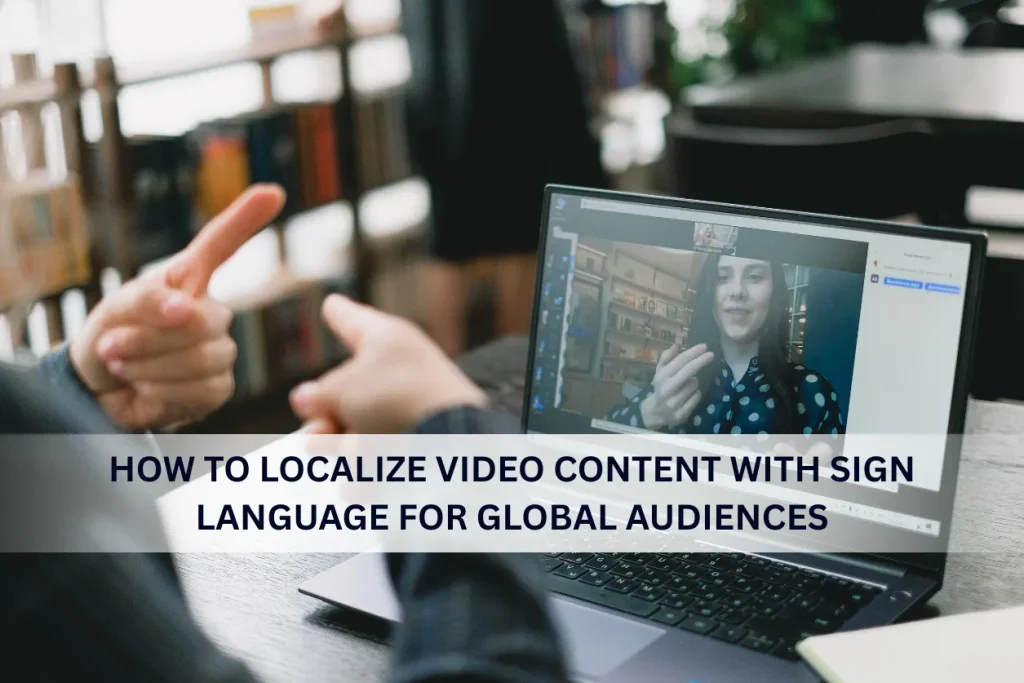
How to Localize Video Content with Sign Language for Global Audiences
This blog explains how to add professional sign language translation to your videos so they’re truly accessible to global viewers — not just through closed captions or SDH subtitles but with native sign language interpreters, AI options, and integrated workflows for streaming platforms, e-learning, corporate training, and OTT catalogs. Follow these steps to make your content compliant, inclusive for hard of hearing and deaf audiences, and commercially ready to scale.
Why sign language localization matters (sign language translation + current trends)
As current trends show, accessibility is now business-critical. Viewers expect media that’s inclusive — not just closed captions or audio description. For millions worldwide who use sign language as their primary spoken language equivalent, sign language translation is the difference between content that’s accessible and content that’s merely visible. Streaming platforms, enterprises, and educational providers are investing in sign language services to reach hard of hearing audiences and comply with legal and corporate accessibility standards. Good sign language implementation also improves engagement, retention, and brand reputation — many benefits that directly impact ROI.
What is sign language localization?
Sign language localization is a layered process. It’s different from captions or SDH subtitles: captions transcribe audio into white text for those with hearing impairments, while SDH subtitles include speaker IDs, control codes, and sound descriptions. Sign language interpreters provide a visual, language-native experience using grammar and vocabulary unique to each sign language (for example, ASL has a different syntax than spoken English). For global audiences you may need multiple variants — American Sign Language (ASL), British Sign Language, or other regional forms — because sign languages are not one language and are culturally situated.
Why you should think beyond captions (hard of hearing and deaf community)
Closed captions and SDH subtitles are vital — they capture audio elements like dialogue, sound effects, and music cues — but they don’t replace sign language for viewers who communicate primarily via signing. Captions are often tiny dots of white text on a black background, and while they help the hard of hearing, they do not communicate facial expressions, body language, or visual grammar. Integrating sign language interpreters addresses that gap and helps your content be genuinely accessible, especially on streaming platforms where audiences expect professional delivery.
Step 1 — Define your regions and select the right sign language
Start by mapping your target markets. Don’t assume one sign language will work everywhere. A production intended for the U.S. should consider American Sign Language; a UK release needs British Sign Language. For global releases you may need multiple interpreter tracks or localized recorded inserts. Consider cultural references that won’t translate directly: date formats, idioms, and visuals that rely on spoken language context must be adapted during the translation process.
Step 2 — Adapt the source language for sign delivery
Sign languages are visual languages with their own grammar and pacing. A literal, word-for-word translation from the source language will look odd and confuse viewers. The adaptation process should be handled by professionals who can translate both meaning and context, adjusting metaphors, speech-dependent jokes, and references so the sign conveys the same intent. Experienced sign language interpreters and translators collaborate to produce an interpretation that respects grammar, vocabulary, and cultural nuance.
Step 3 — Choose the right delivery format (live interpreters, pre-recorded, or AI avatars)
There are three common formats:
- On-camera live interpreters: Best for events, webinars, and live broadcasts. They provide immediacy but require coordination and staging.
- Pre-recorded interpreter inserts: Common for on-demand videos and streaming platforms. They allow higher production quality and tighter synchronization.
- AI sign language avatars: Emerging in 2026 as a scalable, cost-effective option, but currently limited in nuance and facial expression. For commercial content where brand tone matters, a hybrid approach (AI + human review) often works best.
Each choice affects cost, quality, and viewer experience — weigh them against your audience needs and compliance requirements.
Step 4 — Design the video layout & visual integration (screen, audio elements, other audio elements)
Good visual integration matters. Use picture-in-picture or a side panel so the interpreter doesn’t cover important on-screen text or graphics. Ensure contrast (avoid bitmap images that interfere with hand shapes), proper framing, and consistent lighting so sign language is legible. Remember to keep other audio elements like sound effects and music at levels that don’t distract visual communication. Plan “screen-safe” zones for different streaming platforms, and test on actual devices to confirm visibility for viewers with different screen sizes.
Step 5 — Synchronization & quality control (synchronization with spoken language, accuracy review)
Timing is critical. The interpreter must align with speech and other audio cues without crowding the viewer’s attention. Quality control requires native signers to review facial expressions and non-manual signals — these often carry meaning in sign languages. Ideally, have at least two native reviewers: one for linguistic accuracy and one for cultural appropriateness. For recorded work, ensure the final file integrates smoothly with captions and SDH subtitling so viewers can choose their preferred mode of access.
Step 6 — Combine sign language with SDH subtitles and other services (sdh subtitles, audio description, dubbing)
Best practice is an integrated accessibility package. SDH subtitles, audio description for visually impaired viewers, and sign language interpretation together make content accessible across a spectrum of needs. When distributing on streaming platforms, provide separate files or selectable tracks so viewers can enable the mode that suits them. This layered approach ensures your media is inclusive and search-friendly, and it helps platforms find SDH and sign language tracks during ingestion.
Use cases: Where sign language localization shines (streaming platforms, e-learning, corporate)
- Streaming platforms: Improve discoverability and audience retention by adding sign language tracks alongside closed captions and audio dubbing.
- Corporate training & compliance: Sign language helps meet legal obligations and reach employees with hearing impairments.
- E-learning & public sector: Accessibility increases comprehension, especially when complex visuals or data are involved.
Common mistakes to avoid
- Relying solely on automated translation without native review.
- Using poor lighting, framing, or contrast that reduces legibility.
- Treating sign language as a decorative overlay rather than a linguistic service.
- Not offering SDH subtitles or audio description alongside sign language.
- Choosing the wrong regional variant of sign language for your audience.
Cost factors & production planning
Costs vary with video length, live vs recorded formats, studio production needs, and regional availability of interpreters. Pre-produced studio interpretation and integrated post-production editing generally cost more than basic captioning, but they deliver professional results and broader reach. When planning, include review cycles, native reviewer fees, and platform encoding work. If you need help estimating budgets and timelines, consult experienced providers who bundle sign language with subtitling and dubbing services.
The future of sign language in global media
Current trends point to wider adoption: real-time AI assistance, higher OTT compliance, and increased demand from brands prioritizing inclusion. AI avatars will improve, but human interpreters will remain essential for nuance and trust. As more countries strengthen accessibility laws, sign language integration will move from “nice to have” to “must have” — and early adopters will gain brand advantage.
Why partner with DUBnSUB
For businesses targeting global audiences, integrating sign language into video content is a strategic imperative. An end-to-end partner can manage interpreter sourcing, script adaptation, studio recording, SDH subtitling, and final file delivery optimized for streaming platforms. The right provider ensures your content is accessible, compliant, and high quality — helping you communicate with deaf and hard of hearing communities while boosting discoverability and trust.
Ready to make your videos accessible worldwide? Reach out to DUBnSUB for a tailored sign language translation plan that fits your audience, budget, and platform requirements.
Frequently Asked Questions (FAQs)
1. What does it mean to localize video content with sign language?
It means adapting your video for a specific region by integrating the appropriate sign language variant, ensuring accurate interpretation, synchronization, and culturally relevant delivery. This makes your content accessible and meaningful to deaf and hard of hearing audiences in that market.
DUBnSUB provides end-to-end sign language localization services — including script adaptation, certified interpreter sourcing, studio recording, editing, and final platform-ready delivery.
2. Is sign language universal, or do I need different versions for different countries?
Sign language is not universal. Each country has its own structure, grammar, and vocabulary. If you are targeting multiple regions, you may need separate localized versions.
DUBnSUB manages multi-region sign language projects by sourcing native interpreters for each target market and producing customized versions aligned with regional audience needs.
3. How is sign language different from closed captions or SDH subtitles?
Closed captions and SDH subtitles convert audio into text, including speaker IDs and sound cues. Sign language, however, is a complete visual language with its own grammar and expressive elements. Many members of the deaf community rely on sign language as their primary mode of communication.
DUBnSUB integrates professional sign language interpretation alongside SDH subtitles, audio description, and dubbing to deliver fully accessible video solutions.
4. What is the best format for adding sign language to a video?
Options include live interpreters for events, pre-recorded interpreter overlays for on-demand content, or AI-assisted avatars for scalable projects. The right format depends on your content type, distribution platform, and audience expectations.
DUBnSUB evaluates your video objectives and recommends the most effective solution — managing interpreter coordination, studio production, editing, and seamless integration.
5. Can streaming platforms support sign language versions?
Yes, many streaming platforms allow picture-in-picture sign language inserts or alternate video tracks. However, each platform has specific technical and formatting requirements.
DUBnSUB prepares sign language video assets in compliance with OTT and streaming specifications, ensuring smooth ingestion and distribution without delays.
6. What production factors are important for sign language localization?
Proper framing, lighting, contrast, synchronization, and native linguistic review are critical for clarity and comprehension. Poor integration can reduce effectiveness.
DUBnSUB follows structured quality assurance workflows, including native signer reviews and post-production optimization, to ensure professional, broadcast-ready output.
7. Does adding sign language improve brand value?
Yes. Inclusive video content strengthens brand credibility, broadens audience reach, and demonstrates commitment to accessibility and corporate responsibility.
DUBnSUB helps businesses turn accessibility into a strategic advantage by delivering high-quality, inclusive media solutions tailored to global markets.
8. How long does it take to localize a video with sign language?
Timelines vary based on video length, number of target regions, interpreter availability, and production complexity. Smaller projects may take a few days, while multi-market rollouts require coordinated scheduling.
DUBnSUB provides clear project timelines, dedicated project management, and scalable production support to ensure timely delivery for global releases.