
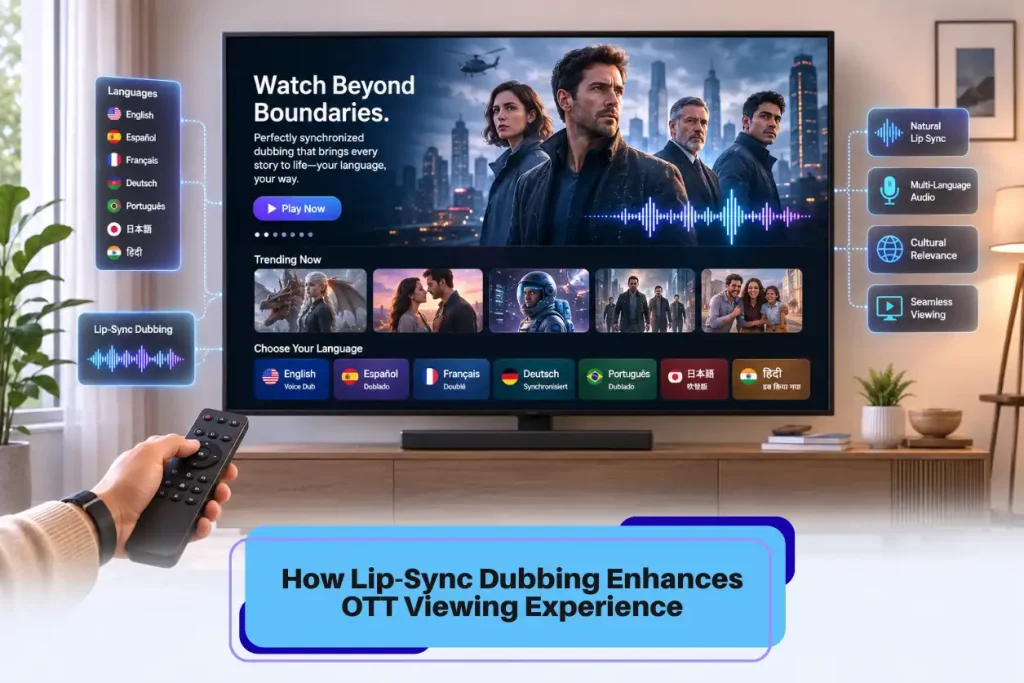
How Lip-Sync Dubbing Enhances the OTT Viewing Experience
Lip-sync dubbing is the process of replacing a film or show’s original dialogue with a translated performance that matches the actor’s mouth movements, timing, and emotion, so viewers on OTT platforms can watch content in their own language without reading subtitles or feeling disconnected from the story. For streaming platforms competing for attention across dozens of markets, this single production step often decides whether a show gets watched to the end or abandoned in the first ten minutes. As OTT libraries grow more global, lip-sync dubbing has moved from a nice-to-have to a core part of how content reaches new audiences.
What Is Lip-Sync Dubbing and Why It Matters
At its core, lip-sync dubbing is about more than swapping language; it’s about swapping performance while keeping the original intent intact. A dubbing artist doesn’t just translate a line of dialogue, they re-perform it, matching pacing, breath, and mouth shape so the new audio feels native to the visual. This is different from a straight voice-over, which sits on top of the original track without trying to match lip movement.
The reason this matters so much for OTT platforms is simple: audiences prefer natural performances over perfect synchronization in dubbing. A viewer will forgive a slightly imperfect lip match far more easily than they’ll forgive a flat, robotic delivery that strips the emotion out of a scene. That’s why human dubbing, built on trained actors who understand pacing, humor, and tension, remains the standard for premium content, documentaries, and animation alike.
The Localization Process Behind Every Dubbing Project
A strong localization process starts long before anyone steps into a recording booth. Translators first adapt the script, then a director and dubbing team work through phonetic matching to align dialogue with the original actor’s lip movements, adjusting word choice and sentence length so the translated line fits the same mouth shapes and timing as the source. Different languages have distinct syllable structures and word lengths, which means a line that takes three seconds in English might need a completely different sentence structure to fit the same three seconds in Spanish or Japanese.
Emotion and performance mapping is a key part of this process too. It helps preserve the original acting integrity across languages, so a whispered threat or a nervous laugh lands the same way in the dubbed version as it did in the original. Visual monitoring helps actors synchronize their performances with the original footage, watching the source scene in real time as they record so timing, gesture, and dialogue stay connected. Once individual lines are recorded, Automated Dialogue Replacement, or ADR, is used to clean up or replace original dialogue in the same language during post-production, tightening the final audio before it’s ever mixed with the localized track.
Reaching Global Audiences Through a Trusted Localization Service
OTT platforms don’t grow by staying local. A show that performs well domestically only unlocks its full value once it’s available to global audiences in a language they actually watch in. This is where a dependable localization service becomes part of the content strategy rather than an afterthought. The data backs this up directly: 72% of consumers prefer content in their native language, which means a title without proper dubbing or subtitling is competing at a structural disadvantage the moment it launches in a new market.
A capable localization company manages this at scale, coordinating translators, dubbing artists, sound engineers, and quality reviewers across multiple languages and tight deadlines without losing consistency from one title to the next. For streaming catalogs releasing dozens of titles a month, having one workflow that can move a project from script to final mix across several languages is what keeps international releases on schedule.
Cultural Sensitivity: The Heart of Media Localization
Language is only one layer of media localization. Cultural sensitivity is what determines whether a joke, an idiom, or a piece of dialogue actually lands the way it was meant to. Cultural adaptation is necessary to maintain the meaning of jokes and idioms in dubbing, because a literal translation of humor or slang rarely survives the trip into another language.
Direct translations can lead to significant cultural misinterpretations, so cultural references often need complete rewriting rather than a word-for-word swap. A joke built around a local celebrity or regional food may need to be replaced entirely, while preserving the original tone and comedic timing. Cultural adaptation prevents misunderstandings in translated content, and skipping it is one of the fastest ways poor dubbing can weaken a brand’s message and engagement. Translators must adapt idioms and humor with real cultural fluency, not just bilingual ability, which is why localization combines cultural intelligence with linguistic precision rather than treating translation as a mechanical task.
Localization Testing: Where Human Dubbing Meets Precision
Recording the dialogue is only half the job. Localization testing is the quality control stage where every episode is checked for lip alignment and audio-visual sync before it ships to viewers. This step catches the small mismatches, a word that lags half a second behind the mouth movement, or a line that cuts off before the actor’s lips stop moving, that would otherwise pull a viewer out of the story.
Lip-sync dubbing requires precise timing to match dialogue with visible mouth movements, and this becomes even more demanding with animation. Lip-syncing is crucial for animation to match audio tracks with character mouth movements, since animated characters often have simplified or exaggerated mouth shapes that need their own timing rules separate from live-action footage. Once sync is confirmed, the final mix blends the dubbed dialogue with sound design and music for a seamless experience, so background score, ambient sound, and dialogue all sit together the way they did in the original release.
Serving Different Languages Through a Trusted Localization Company
No two languages behave the same way on screen. A localization company working across different languages needs native linguists in each target language, not just fluent speakers, because tone, rhythm, and regional expression vary widely even within the same language family. A Spanish dub for Latin America won’t sound right if it’s built around the vocabulary and rhythm of European Spanish, and a French dub aimed at Canadian audiences needs its own local expertise separate from a Parisian voice cast.
This is why deep understanding of a target market matters as much as translation accuracy. Dubbing replaces original dialogue with target language performances that need to feel like they were written for that audience from the start, whether the content is a documentary, a film, an animated series, or a corporate training video. Subtitling remains a valuable companion service here too. Subtitling displays translated text at the bottom of the screen for viewers who prefer reading along, while audio descriptions help visually impaired viewers understand content through narrated visual detail, both forming part of a complete audiovisual translation strategy that adapts content for cultural relevance and understanding.
Why Expert Localization and Local Expertise Deliver Global Reach
For OTT platforms entering new markets, working with a partner that combines expert localization with a global network of native linguists and dubbing artists is what makes scale possible without sacrificing quality. Language localization is a primary use of lip-sync dubbing for translating content across markets, but the real value comes from local expertise, teams who understand not just the language but the humor, pacing, and viewing habits of a specific region.
DUBnSUB brings this combination together for OTT platforms, production houses, and content owners who need cost effective, quality results across multiple languages without managing separate vendors for translation, dubbing, subtitling, and testing. Our team of native linguists, dubbing artists, and localization specialists works as one workflow from script adaptation through final mix, so a project can move from original content to a fully localized release ready for new markets, even on tight deadlines. Whether the goal is expanding into Latin America, adapting a documentary for a new language, or localizing an entire animated series, DUBnSUB’s global reach and human dubbing approach keep the original emotion, humor, and storytelling intact for every audience.
Frequently Asked Questions (FAQs)
1. What is the difference between lip-sync dubbing and regular voice-over?
Lip-sync dubbing matches the translated dialogue to the actor’s mouth movements and timing, while a standard voice-over is layered over the original audio without trying to align with lip movement. DUBnSUB’s dubbing process uses trained human talent and phonetic matching to deliver lip-sync dubbing that feels native to the original footage, not just translated audio placed on top of it.
2. Why do OTT platforms need dubbing instead of just subtitles?
Many viewers prefer to watch and listen rather than read subtitles throughout an entire film or series, especially for fast-paced dialogue or emotional scenes. DUBnSUB offers both dubbing and subtitling services so OTT platforms can offer viewers a choice, without managing two separate vendors for the same content.
3. How is cultural sensitivity handled during the localization process?
Cultural sensitivity means adapting jokes, idioms, and references so they make sense to the new audience rather than translating them word for word. DUBnSUB’s native linguists rewrite culturally specific content where needed, keeping the tone and comedic timing intact for each target market.
4. What happens during localization testing for a dubbed project?
Localization testing checks lip alignment, audio-visual sync, and overall audio quality before a project is delivered, catching timing issues that a viewer would otherwise notice. DUBnSUB runs every project through a dedicated quality control stage before final delivery, so OTT platforms receive a broadcast-ready file.
5. Can dubbing be done across multiple languages at once for a single title?
Yes, a title can move through translation, dubbing, and testing in several languages in parallel, provided the production team is coordinated under one workflow. DUBnSUB manages multi-language dubbing projects for OTT platforms and production houses through a single point of contact, keeping timelines and quality consistent across every language version.
6. Is human dubbing still used for animation and documentaries?
Yes, human dubbing artists remain the standard for animation and documentaries because they can match emotional tone, comedic timing, and natural pacing in ways that require real performance judgment. DUBnSUB’s dubbing artists specialize across genres, including animation and documentary work, adapting delivery to match the specific demands of each format.
7. How does a localization company handle tight deadlines without lowering quality?
A localization company manages tight deadlines by running translation, dubbing, and quality checks in parallel workflows with dedicated teams for each language, rather than handling every step sequentially. DUBnSUB’s global network of native linguists and dubbing artists allows projects to move quickly across languages while every episode still passes through full localization testing before delivery.