
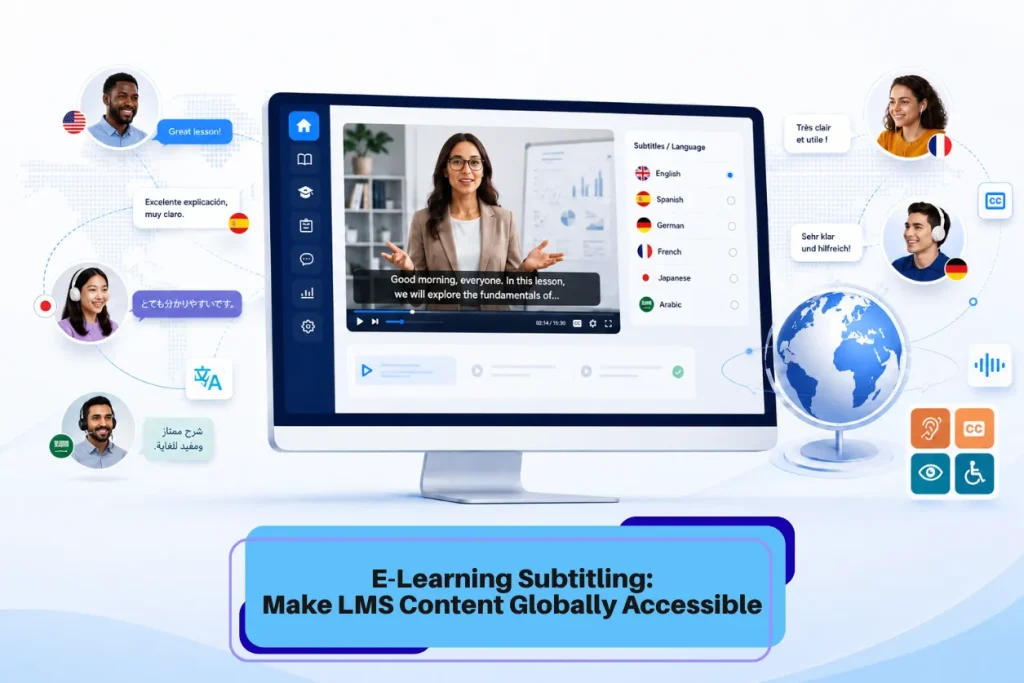
E-Learning Subtitling: Making LMS Content Accessible to Global Learners
E-learning subtitling services convert the spoken audio in online courses into synchronized on-screen text in a learner’s native language, so that training videos, lectures, and multimedia elements inside a learning management system can be understood by global learners regardless of the language they speak or their hearing ability. For organizations running a learning platform across multiple countries, subtitling is what turns a single English-language course into a localized version that works for learners worldwide, supports learner comprehension, and meets accessibility requirements such as WCAG 2.2. This is the foundation of e-learning localization, and it’s the service this blog walks through in detail.
ELearning Subtitling Services: What They Actually Involve
Subtitling for a learning platform is not the same as subtitling a film or a marketing video. Elearning content is built around learning outcomes — a learner needs to retain key concepts, follow a sequence of steps, and often pass an assessment afterward. That changes what “accurate” subtitles look like.
A proper subtitling process for online courses includes:
- Transcription of the original training videos or e learning videos
- Translation into the target language, with attention to subject matter accuracy
- Timing and synchronization so subtitles match narration and on-screen demonstrations
- Formatting subtitles in the right subtitle format for the destination learning management system
- Quality review by subject matter experts, not just linguists
Because e-learning content frequently covers compliance training, medical training, or technical procedures, translation accuracy matters more than it does in general video content. A mistranslated instruction in a safety module or medical training video isn’t a stylistic issue — it’s a risk.
Why Native Language Subtitles Matter for Learner Engagement
Learners absorb information faster and retain it longer when it’s delivered in their native language. This isn’t just intuition — it reflects how the brain processes audiovisual translation. Pairing audio with text improves memory and information recall, and subtitles give learners a second channel to reinforce what they’re hearing.
For non-native speakers, subtitles do three specific things:
- They support pronunciation and vocabulary building for language learners working through multilingual training.
- They provide visual reinforcement for complex concepts and unfamiliar terminology.
- They let learners follow course content in noisy environments, or with audio off entirely — an underrated but common real-world scenario in corporate training.
Multilingual subtitles also widen access. Over 5% of the global population has some form of disabling hearing loss, and subtitles support learners with hearing impairments and dyslexia by giving them equal access to the same course content as everyone else. This isn’t a side benefit — under WCAG 2.2, captions for prerecorded training videos are a baseline requirement, not an optional add-on.
Elearning Translation: From Course Content to Target Language
A good elearning translation project starts with the source course content and ends with a fully functional, localized version inside the LMS — not just a translated script. The translation process typically runs through these stages:
Content and terminology mapping. Educational videos often require glossary and terminology management so that key concepts are translated consistently across every module, quiz, and supporting document in a course.
Translation by subject matter specialists. Compliance training, technical training, and medical training all use specific vocabulary. Translators need deep understanding of both the target language and the subject matter to avoid translation errors that change meaning.
Cultural adaptation. Examples, currency, measurement units, humor, and cultural references that make sense in the original market often need to be reworked for global audiences. This is where cultural adaptation and cultural relevance separate a translated course from a properly localized one.
Technical formatting. Subtitles need to be delivered in SRT or WebVTT — the two preferred subtitle formats for LMS platforms — and tested for compatibility with SCORM and xAPI packages so the localized course behaves identically to the original inside any learning management system.
Localizing Elearning Content: Cultural Adaptation for Complex Concepts
Localizing elearning content goes further than word-for-word translation. An elearning localization project has to account for how different languages structure information, how long text takes to read on screen, and how cultural context shapes the way an example or a case study lands with a learner.
This matters most with complex concepts — a compliance scenario, a clinical procedure, a piece of software walkthrough — where a subtitle that’s technically correct but culturally or contextually off can confuse rather than clarify. Good localization also touches the user interface of the course itself: menus, buttons, quiz prompts, and navigation elements often need adapting alongside the subtitles, since a learner shouldn’t have to switch mentally between a localized video and an untranslated interface.
Video Content and Learner Retention: The Case for Subtitles
Video content is now the backbone of most digital learning content, and how well learners retain it depends heavily on how it’s presented. Subtitles enhance comprehension and retention for a wide range of learners — visual learners, non-native speakers, and anyone processing training material in a second language.
The mechanism is straightforward: reading along with narration reduces cognitive load, reinforces vocabulary and pronunciation, and helps learners hold onto key concepts longer after the course ends. Culturally adapted, accurately timed subtitles measurably improve learner engagement and knowledge retention compared to audio-only training videos — which is exactly why subtitling has become standard practice for multilingual training programs and elearning platforms serving learners worldwide.
Presentation matters too: high-contrast, clear fonts that stay readable against different video backgrounds are a small but important part of the subtitling process, since illegible captions defeat the purpose regardless of translation quality.
Elearning Platform Compatibility: Testing and LMS Support
Subtitles don’t exist in isolation — they have to work inside whatever elearning platform or LMS a company already uses. This is where many in-house localization efforts break down. Proper testing is essential to confirm that localized subtitles display correctly, sync with playback, and don’t break other functionality across different LMS platforms and devices.
A few technical realities worth knowing:
- LMS localization involves adapting user interfaces and navigation elements, not just video content.
- SCORM and xAPI compatibility should be verified for every language version, not just the original.
- Ideally, an LMS should support multi-language content assignment automatically, so learners are routed to the correct language version without manual setup.
- Translation management systems help keep terminology and formatting consistent across a growing library of course content and language versions.
Skipping this step is one of the most common reasons localized courses look fine in isolation but fail once deployed inside a live learning platform.
Subtitling Services for Global Learners: Accuracy, Compliance, and Support
For organizations training learners across multiple regions, subtitling services need to deliver on three fronts at once: linguistic accuracy, technical compatibility, and regulatory compliance. Accessibility standards like WCAG and ADA increasingly shape how subtitling services for e-learning are scoped, and localization also has to account for regional training regulations that vary by country and industry.
DUBnSUB provides e learning subtitling services that combine linguistic accuracy with technical precision — covering transcription, elearning translation, cultural adaptation, and subtitle formatting for SCORM- and xAPI-compliant LMS platforms. The team works with subject matter experts across compliance, technical, and medical training content to ensure translation accuracy holds up in regulated environments, and every localized course goes through functional testing before delivery. For organizations rolling out multilingual training to learners worldwide, that combination of human expertise and technical rigor is what separates a translated course from one that’s genuinely accessible.
Frequently Asked Questions (FAQs)
1. What is the difference between translating an e-learning course and subtitling it?
Translation converts the written or spoken content into another language, while subtitling adds that translated text as timed, synchronized captions on screen, formatted for playback inside a specific LMS. DUBnSUB handles both stages together as part of a single elearning subtitling service, so translated text arrives already synced, formatted, and tested for the client’s learning management system.
2. Which subtitle formats work with most learning management systems?
SRT and WebVTT are the two subtitle formats most LMS platforms accept, since both support the timing and text structure needed for SCORM and xAPI packages. DUBnSUB delivers subtitles in whichever format matches the client’s LMS, along with functional testing to confirm playback and sync work correctly before launch.
3. How does subtitling improve learner retention compared to audio-only training?
Subtitles let learners process information through both listening and reading at once, which reinforces memory, supports vocabulary building for non-native speakers, and helps with complex or technical terminology. DUBnSUB’s subtitling process pairs accurate translation with careful timing so the visual and audio channels reinforce rather than distract from each other.
4. Can subtitles help meet accessibility requirements like WCAG 2.2?
Yes — WCAG 2.2 requires captions for prerecorded training videos, and subtitles also support learners with hearing impairments or dyslexia, giving them equal access to course content. DUBnSUB builds accessibility compliance into its subtitling workflow from the start, rather than treating it as a separate add-on step.
5. How is cultural adaptation handled during e-learning localization?
Cultural adaptation adjusts examples, references, units, and context so a course feels natural to learners in the target market, rather than just linguistically correct. DUBnSUB’s translators and subject matter experts review course content for cultural relevance alongside language accuracy, so localized courses read as though they were built for that audience.
6. Why can’t machine translation tools handle e-learning subtitling on their own?
Machine translation struggles with subject matter nuance, cultural context, and technical terminology, which leads to translation errors in regulated or technical training content. DUBnSUB relies entirely on human translators and subject matter experts at every stage, so translation accuracy and cultural adaptation are built in from the first draft rather than corrected after the fact.
7. What kind of testing happens after subtitles are added to a course?
Testing checks that subtitles sync correctly with narration, display properly across devices, and don’t disrupt any interactive elements or quizzes inside the course. DUBnSUB includes functional testing across LMS platforms as a standard part of every subtitling project, so courses work identically to the original once localized.