
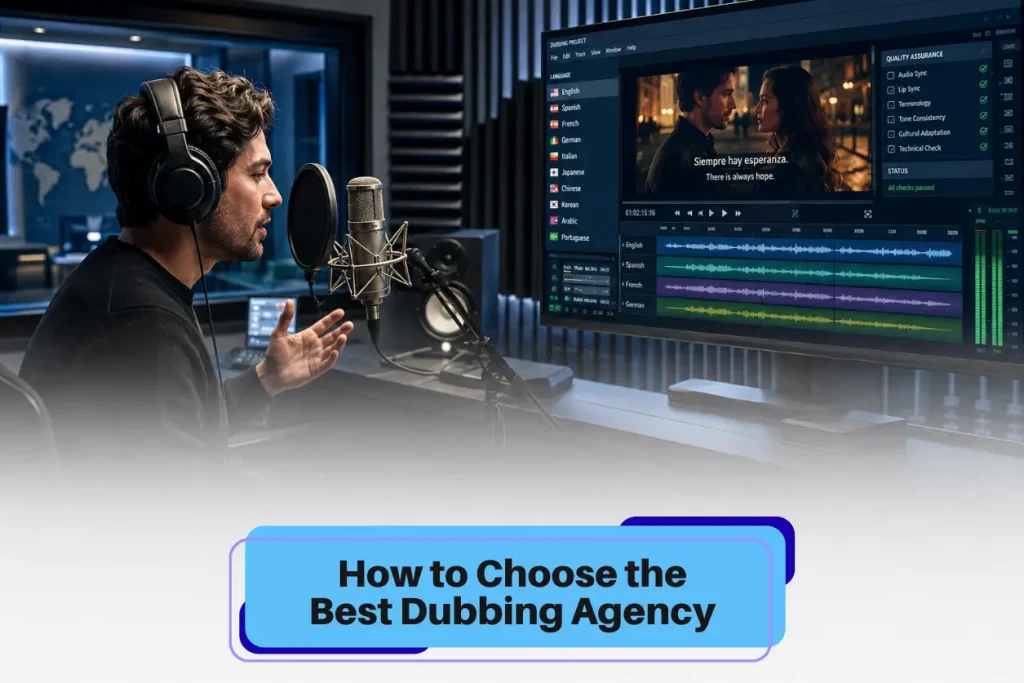
How to Choose the Best Dubbing Agency in 2026
Choosing the right dubbing agency in 2026 means evaluating a partner that can adapt your video content across global languages — preserving the original performance, matching lip sync, and connecting authentically with your target audience. Whether you are a streaming platform, a corporate brand expanding into new languages, or a producer readying a tv series for international audiences, this guide covers everything you need to know: what to look for in a dubbing company, which quality benchmarks matter, how multilingual dubbing workflows operate, and why the voice behind the translation is as important as the translation itself.
Why the Choice of Dubbing Agency Shapes Your Global Reach
Great dubbing is not just a technical exercise. It is the difference between an audience that feels immersed in your content and one that notices the dubbed audio feels off. A skilled dubbing agency handles the entire chain — script adaptation, casting of professional voice actors, studio recording, audio sync, and post production — so that the final output sounds as natural in Spanish or Japanese as it does in the source language.
For streaming platforms with tight deadlines, or brands producing training videos for multiple countries, getting this chain right the first time matters enormously. The wrong choice leads to reshoots, costly revisions, and reputational damage in markets you worked hard to enter.
What to Look for in a Professional Dubbing Agency
Language Coverage and Native Speakers
The foundation of high quality dubbing is native speakers performing in the target language — not translators reading a script aloud. Look for a dubbing company that works with trained voice artists who understand regional accents, cultural cadence, and the emotional register of the original speaker. Whether you need english dubs, french, german, or japanese content, the voice actors should feel local to the audience consuming it.
Quality of Voice Actors and Casting
The best dubbing services maintain deep rosters of experienced professional voice actors across ages, accents, and vocal styles. For animation and scripted drama, casting matters as much as it does on screen. For corporate content and training videos, clarity and authority take precedence. Ask any dubbing agency you are evaluating whether they handle casting in-house, how they match voice to character, and whether you have approval at the casting stage.
Multilingual Dubbing Capabilities
If your project requires delivery across multiple languages simultaneously — common for OTT releases, global product launches, or large-scale e-learning rollouts — your dubbing company needs the production infrastructure to support parallel workflows. Multilingual dubbing at scale requires coordinated dubbing studios, language-specific production managers, and quality control at every stage. A partner with a wide global network of studios keeps turnaround time predictable even when video length is high and languages are numerous.
Lip Sync Precision and Dialogue Adaptation
Accurate lip sync is a core technical requirement for drama, animation, and any content where speakers are visible on screen. This goes beyond timing — it requires experienced dialogue adapters who rewrite lines in the target language to fit mouth shapes and rhythm while preserving the original message. A dubbing agency that shortcuts this step delivers dubbed audio that looks visibly out of step, which breaks viewer trust immediately.
Studio Quality and Post Production Standards
Clean dubbed audio starts with clean recording. Evaluate whether an agency owns or partners with certified dubbing studios that deliver broadcast-grade output — free of background noise, with consistent room tone and technically compliant files. Post production quality, including mix, mastering, and format delivery, should meet the specifications of your target platform or broadcaster. Automated Dialogue Replacement (ADR) is a widely used technique in professional dubbing that re-records dialogue in a controlled studio environment post-filming, correcting any audio imperfections from the original shoot and ensuring the final dubbed audio meets broadcast quality standards.
Turnaround Time and Scalability
For producers working to release schedules, turnaround time is non-negotiable. A professional dubbing agency should be able to provide clear timelines at brief stage, manage tight deadlines through its studio network, and escalate production capacity when project scope grows. Always ask specifically about timelines per language, per video length, and whether rush delivery carries additional cost.
Competitive Rates and Transparent Custom Quotes
Pricing in the dubbing industry varies widely based on language pair, content type, video length, and whether you require lip sync or voice over treatment. The most reliable dubbing agencies provide detailed custom quotes based on your specific project rather than opaque per-minute averages. Competitive rates are important, but the lowest quote rarely reflects the full cost — factor in revisions, quality control rounds, and format delivery when comparing.
AI Dubbing vs. Professional Dubbing: What You Need to Know in 2026
AI dubbing has entered the industry conversation in recent years, and its limitations are becoming just as visible as its initial promise. While modern ai dubbing tools can support over 20 languages and offer voice cloning that attempts to replicate the original speaker’s vocal characteristics, the results frequently fall short when content demands emotional depth, cultural nuance, or precise lip sync. Major platforms have been testing the technology by running AI-generated dub trials — but early adoption at the platform level does not translate to audience-ready quality for serious productions.
The core limitation of ai dubbing is what it cannot replicate: the interpretive intelligence of a trained voice actor. Professional voice actors bring breath, timing, character instinct, and cultural fluency to every line — qualities that determine whether an international audience connects with your content or simply tolerates it. For scripted drama, animation, tv series, corporate brand content, and any project where the original performance carries emotional weight, AI-generated dubbed audio consistently underdelivers on the nuance that human talent brings.
For brands and producers who cannot afford to compromise on how their content lands with global audiences, professional dubbing with skilled native-speaking voice actors remains the only reliable standard. DUBnSUB specialises exclusively in human dubbing and human-assisted dubbing services — with over 3,500 professional voice artists, 200+ partner dubbing studios across 50 countries, and a production process built around preserving the authenticity of the original performance in every target language.
Dubbing vs. Voice Over: Choosing the Right Format
Understanding the difference helps you brief any agency accurately. Dubbing replaces the original audio entirely, with recorded dialogue in the target language synchronized to match on-screen lip movements. It is the standard format for films, tv series, animation, and streaming platforms where audiences expect full immersion. Voice over layers a translated narration over the original speaker — commonly used for documentaries, training videos, corporate communications, and news programs where lip sync is not required. Both formats demand professional voice actors and expert post production; they simply serve different audience expectations and content types.
Checklist: 6 Questions to Ask a Dubbing Agency Before You Sign
Before shortlisting a dubbing company, get direct answers to these six questions:
- Talent: Does your roster include trained voice actors — not just translators — across all the languages I need?
- Lip Sync: How is dialogue adapted for lip sync, and who reviews the script before recording begins?
- Quality Control: What specific checks happen between the recording session and final audio delivery?
- Scale: Can you run multilingual dubbing across several languages simultaneously, and how is that workflow managed?
- Turnaround: What is a realistic timeline for my video length and language count?
- Pricing: Do you provide custom quotes, and what variables affect the final cost?
If any of these are unclear after a first conversation, keep looking.
Ready to bring your content to global audiences? DUBnSUB delivers professional dubbing, voice over, and multilingual localization across 100+ languages — with native talent, broadcast-grade studios, and competitive rates. Get a custom quote today.
Frequently Asked Questions (FAQs)
1. How do I select the best dubbing agency in 2026?
Start by assessing whether the agency works with trained, native-speaking voice actors rather than simply offering translation with recorded narration. Beyond talent, look at their quality control process, ability to handle tight deadlines, language range, and whether they have a track record with content similar to yours — whether that is animation, corporate video, or scripted drama. DUBnSUB brings together over 2,000 professional voice artists, 200+ partner dubbing studios across 50 countries, and dedicated production managers — making it a dependable choice for projects ranging from single-language localization to large-scale multilingual dubbing.
2. What should I look for in a professional dubbing company?
A professional dubbing company should own the end-to-end process: script adaptation in the target language, casting of skilled voice actors, precision lip sync, studio recording, and post production quality checks. Transparency around pricing, turnaround time, and revision rounds are equally important signals of a mature operation. DUBnSUB handles every stage of the dubbing process in-house and through its certified global studio network, offering custom quotes and structured production timelines for each project — with no hidden handoffs or quality gaps between stages.
3. Which dubbing agency is best suited for OTT and streaming platforms?
Streaming platforms demand more than accurate translation — they require an agency fluent in platform-specific delivery formats, capable of simultaneous multilingual output, and experienced with the lip sync precision that drama and animation audiences expect. The right partner will have handled OTT content before and will understand the compliance requirements that come with it. DUBnSUB has a strong track record delivering dubbing, subtitling, and audio description for streaming content, with the technical know-how and global studio reach to meet the exacting standards of major digital platforms.
4. How can I evaluate dubbing quality before committing to an agency?
Ask for demos in the specific languages and content types you need — a corporate training sample is very different from a scripted drama reel. Listen for whether the dubbed audio feels natural to a native ear, whether the emotion of the original performance carries through, and whether lip sync holds up on screen. DUBnSUB’s quality assurance spans every production stage, from dialogue adaptation and voice casting to recording direction and final audio review, ensuring that the output sounds genuinely native rather than translated.
5. What does a dubbing agency need to deliver for film and television productions?
Film and television set the highest bar in the dubbing industry — requiring culturally adapted dialogue, frame-accurate lip sync, broadcast-compliant audio, and delivery that aligns with release windows. The agency must have deep experience with scripted content, a wide enough talent pool to cast the right voice for every character, and the production bandwidth to run multiple language versions in parallel. DUBnSUB specialises in film and TV dubbing, with native-language dialogue adapters, an extensive roster of voice artists across global languages, and a partner studio network capable of scaling to meet demanding production schedules.
6. How should I evaluate a voice-over partner for multilingual projects?
For content going out in multiple languages, consistency matters as much as individual quality — each language version should reflect the same tone, intent, and pacing as the original. Look for an agency with verified native speakers across all required languages, a unified production workflow, and experience managing multilingual rollouts without quality dropping between markets. DUBnSUB delivers professional voice over in 100+ languages through a coordinated global production model, with native voice artists and standardised quality benchmarks applied consistently across every language in a project.
7. What certifications indicate a credible professional dubbing agency?
ISO 9001:2015 demonstrates that an agency manages its operations and quality systems to an internationally recognised standard. ISO 17100 specifically covers translation and language services, signalling rigorous linguistic and production practices. Membership in industry bodies such as ELIA further reflects a commitment to professional standards across the localization sector. DUBnSUB holds both ISO 9001:2015 and ISO 17100 certifications and is an ELIA member — giving clients third-party validated assurance of the quality and process discipline behind every project.
8. Can a dubbing agency also handle subtitling and audio description for the same project?
Working with a single agency across dubbing, subtitling, and audio description reduces the risk of inconsistency in terminology, tone, and translation — and significantly simplifies project coordination. Many broadcasters and streaming platforms now require all three formats for a single release, so full-service capability is a practical advantage. DUBnSUB offers integrated dubbing, voice over, subtitling, SDH subtitling, and audio description across 100+ languages, allowing clients to manage their entire audiovisual localization workflow through one experienced production team.
9. How much does professional dubbing cost compared to AI dubbing?
Professional dubbing with human voice actors typically ranges from a few hundred to over a thousand dollars per finished minute per language, depending on content complexity, lip sync requirements, and the agency’s market positioning. AI dubbing tools, by contrast, offer significantly lower entry points — some platforms provide subscription-based access for high-volume content needs at a fraction of the per-minute cost of human dubbing, though with trade-offs in emotional nuance and cultural adaptation. For premium scripted content, the investment in professional voice actors consistently delivers stronger audience engagement and viewership uplift. DUBnSUB specialises exclusively in human dubbing, working with professional voice actors across 100+ languages to deliver the quality, emotional authenticity, and cultural accuracy that AI tools cannot replicate — with custom quotes tailored to your content type, language count, and turnaround requirements.