
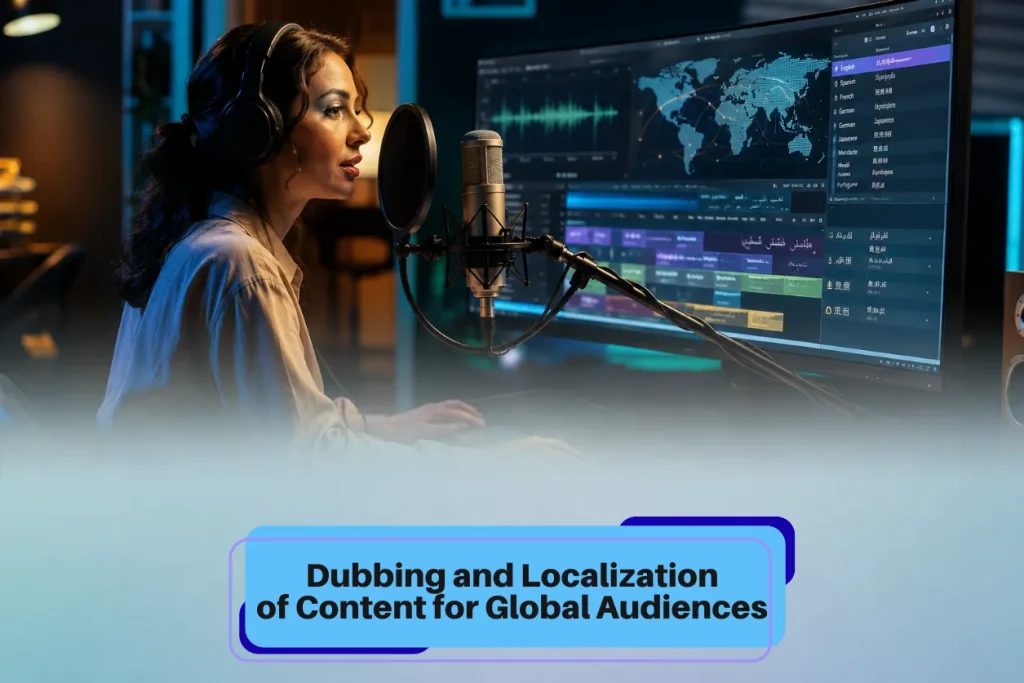
Dubbing and Localization for Global Audiences: A 2026 Guide
Dubbing and localization for global audiences means adapting audio and video content — dialogue, on screen text, sound effects, and cultural references — so it feels native to viewers in a new market, rather than simply translated. This blog is for marketing teams, L&D managers, and content owners who need to take existing content into new markets in 2026, and it walks through how dubbing services, subtitle translation, and a clear localization strategy work together to protect translation quality while reaching a global audience. Getting this right matters because a translated video that ignores cultural context and cultural preferences rarely performs — it can hurt viewer retention, brand voice, and even search engine visibility in the target language. Below, we break down what content localization services actually involve, how to choose between dubbing and subtitles, and what a professional localization strategy looks like in practice.
What Are Content Localization Services and Why They Matter for Video Content
Content localization services go well beyond simple translation. For video content, localization touches spoken dialogue, on screen text, graphics, sound effects, and even pacing, so the final piece feels like it was made for the target audience rather than adapted for them. This distinction matters because global consumers can tell the difference between localized content and a rushed, word-for-word conversion — and that difference shows up directly in translation quality, engagement, and trust.
A strong video localization strategy starts with subject matter expertise. Whether the source is a product demo, an educational video, or a training video for internal teams, the localization team needs to understand the subject well enough to preserve meaning, not just words, when adapting for a new market. At DUBnSUB, this is handled by native speakers with cultural expertise in the target language, supported by a global network of voice talents and linguists across multiple markets — not by a single automated pass.
Understanding Your Target Language and Audience Before You Localize
Before any script translation or voice over work begins, it’s worth mapping out exactly who the target audience is and what they expect from audiovisual content in their own language. A landing page aimed at business buyers in Germany needs a different tone than a social media content piece aimed at younger viewers in Brazil, even if the underlying video content is the same.
This is where a clear localization strategy pays off. Teams that plan for multiple languages from the start — rather than localizing one market at a time — tend to get better consistency in brand voice and faster turnaround when expanding to new markets. It also helps identify early which visual elements (on screen graphics, charts, product shots) will need adaptation alongside the audio, since not every element translates cleanly across different markets.
Dubbing Services vs Subtitle Translation: Choosing the Right Localization Strategy
One of the most common questions in video localization is whether to use dubbing services or subtitle translation — and the honest answer is that it depends on the content and the international market you’re targeting.
Dubbing services replace the original audio with a professionally recorded voice over in the target language, matched to the tone, pacing, and lip movement of the original video where needed. This works well for educational videos, entertainment content, and any audiovisual content where viewers are expected to watch closely without reading. Voice casting is critical here — the right voice talents can carry brand voice and emotional tone across languages in a way that a flat reading cannot.
Subtitle translation, by contrast, keeps the original audio and overlays accurate subtitles or multilingual subtitles in the target language. It’s typically faster to produce, more cost effective at scale, and preferred for corporate communications, internal training content, and social media, where viewers often watch with sound off. Subtitle creation also supports closed captions for accessibility compliance, which many organizations now require across their digital presence.
Many localized videos actually use both — dubbed audio for the primary market release, and subtitle translation as a lighter-touch option for secondary markets or social platforms.
Translation Services and Search Engine Optimization: How Localization Boosts Organic Traffic
Localization isn’t only a viewer-facing exercise — it has a direct line to search engine optimization. Localized video content, when paired with translated titles, descriptions, and accurate subtitles, gives search engines more indexable text in the target language, which improves discoverability in local search results. Video translation of on-screen text and metadata also helps landing pages built around that content rank for local keywords rather than relying solely on the original language.
This is one reason translation services and SEO-minded content teams increasingly work together: a well-localized video can drive organic traffic in a new market the same way a well-optimized blog post does in its home market, provided the translation quality is high enough to read naturally rather than mechanically.
Cultural Adaptation in Post Production
Cultural adaptation is where localization moves from “correct” to “resonant.” In post production, this might mean adjusting sound effects that carry different connotations, replacing cultural references that won’t land with a new audience, or reworking humor and idioms that don’t translate literally. Skipping this step is the most common reason localized videos still feel foreign despite accurate language conversion.
Human review at this stage is non-negotiable. Automated, machine-driven translation can miss cultural nuance, tone, and native-level phrasing entirely, which is why DUBnSUB relies on native speakers and professional transcription and voice teams reviewing every stage of script translation and post production, without sacrificing quality for speed.
Localization for Corporate Communications and Social Media
Corporate communications and social media content have very different localization needs. Internal training videos and corporate communications usually prioritize clarity, consistent terminology, and subject matter expertise — accuracy matters more than style. Social media content, on the other hand, needs to feel native and current, often requiring faster turnaround and closer attention to cultural preferences and platform norms in each target market.
A good localization strategy accounts for both: consistent brand voice and translation quality across corporate materials, and more flexible, culturally attuned adaptation for content meant to perform on social media across multiple markets.
File Formats and Technical Considerations for Global Video Localization
Finally, practical execution matters. Different platforms and use cases call for different file formats — from standard subtitle files compatible with major video platforms to broadcast-ready dubbed audio tracks and localized on-screen graphics files. Working with a team that understands file formats end to end, from original video through final delivery, avoids costly rework when content moves between platforms, regions, or post-production teams.
Frequently Asked Questions (FAQs)
1. What’s the difference between dubbing and subtitle translation?
Dubbing replaces the original audio with a voice over recorded in the target language, while subtitle translation keeps the original audio and adds translated text on screen. Dubbing suits content where viewers watch closely; subtitles work well when speed, cost, or accessibility matter more. DUBnSUB offers both dubbing services and subtitle translation, so teams can choose the right mix for each market and platform.
2. How long does video localization typically take?
Turnaround depends on video length, number of target languages, and whether dubbing or subtitles are needed, but most single-language subtitle projects move faster than full dubbing with voice casting and post production. DUBnSUB’s global network of linguists and voice talents allows parallel work across multiple languages, keeping delivery timelines predictable even at scale.
3. Does localized video content actually help with SEO?
Yes — localized titles, descriptions, and accurate subtitles give search engines more text to index in the target language, which can improve visibility in local search results. DUBnSUB includes SEO-aware metadata and subtitle formatting as part of its localization services, so localized videos are built to perform, not just translate.
4. Can automated translation tools handle dubbing and subtitles on their own?
Automated translation can produce a rough draft, but it consistently misses cultural adaptation, tone, and the natural-sounding dialogue needed to feel authentic to native speakers. DUBnSUB relies on human linguists, voice talents, and transcription specialists at every stage, so translation quality is never left to guesswork.
5. What file formats do I need for multilingual subtitles?
It depends on the platform — broadcast, streaming, and social media each have different subtitle and caption format requirements. DUBnSUB handles file formats end to end, delivering subtitles and captions ready for whichever platform or region the content is going to.
6. Is dubbing worth it for training and educational videos?
It depends on the audience — dubbing often improves comprehension and engagement for training videos and educational videos where learners need to focus on visuals, not reading. DUBnSUB provides voice casting suited to instructional tone, making dubbed training content sound natural rather than robotic.
7. How do you keep cultural adaptation from changing the original message?
The goal is to preserve intent and meaning while adjusting references, humor, or phrasing that won’t land the same way in the target language. DUBnSUB’s native-speaker linguists work closely with subject matter context to keep messaging accurate while making it feel locally authentic.