
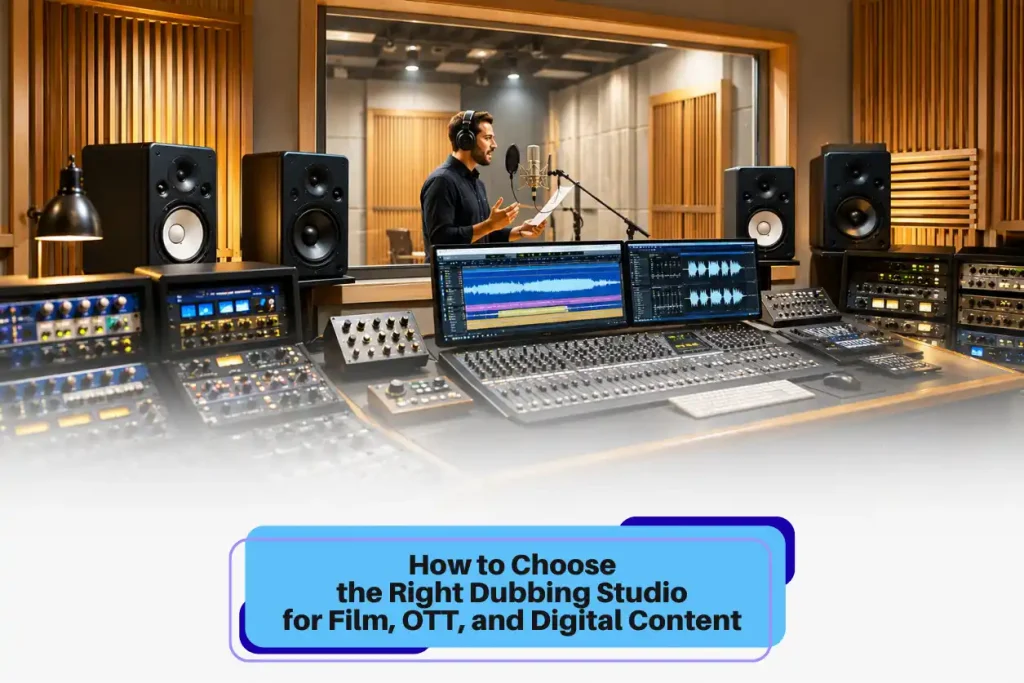
How to Choose the Right Dubbing Studio for Film, OTT, and Digital Content
Choosing the right dubbing studio means evaluating a dubbing company’s casting process, translation quality, technical capabilities, and turnaround speed to make sure your film, OTT series, or digital content sounds as natural in a new language as it did in the original. The right partner handles the full process end to end — script translation, talent casting, voice recording, audio mixing, and often subtitling too — while preserving the original message, emotion, and cultural context of the source material. This blog breaks down exactly what to look for, so producers, distributors, and content teams can pick a dubbing studio with confidence rather than guesswork.
Whether you’re localizing a feature film for international release, adapting a drama series for a streaming platform, or preparing a corporate video for global audiences, the studio you choose has a direct impact on how your content is received. A rushed or mismatched dub can undercut a strong original performance; a well-run one can make a story feel like it was made for that audience all along.
What Makes a Dubbing Studio the Right Choice for Your Project
Not every dubbing studio is built for every kind of project. Some specialize in animation, others in live action, corporate training, or advertising. Before signing on with a studio, look closely at their portfolio, their process, and how they talk about quality.
A few factors matter more than others:
- Casting. Does the studio have a global network of professional voice actors who can match the tone, age, and personality of each character?
- Translation quality. Is script adaptation handled by native speakers with genuine fluency in the target language, not just literal translation?
- Technical capabilities. Can the team manage lip-syncing, audio mixing, and ADR (automated dialogue replacement) to professional broadcast or streaming standards?
- Track record. Has the studio worked across multiple languages and different countries, and can they show real client results?
A studio that’s ranked number one in client satisfaction usually earns that reputation through consistency across all four of these areas, not by excelling at just one.
Dubbing Company vs Freelance Talent: Why Structure Matters
It’s tempting to assemble a dub through individual voice artists and a freelance editor to save cost. For a single short video, that can work. For a film, TV series, or ongoing content pipeline, it usually doesn’t hold up.
A dubbing company brings a coordinated team: casting directors, translators, sound engineers, and quality assurance reviewers who all work from the same brief. This matters because dubbing involves many moving parts — translation, talent casting, voice recording, and audio mixing — and each stage depends on the one before it. A structured dubbing company can also scale a project across multiple languages at once, keeping voice direction and tone consistent, which is nearly impossible to coordinate manually across a dozen freelancers.
Cost is naturally part of the decision. But the more useful question isn’t “what does this dubbing studio charge,” it’s “what am I getting for that cost” — a single voice file, or a fully quality-checked, broadcast-ready asset.
Voice Cloning and the Future of Voice Casting
Voice cloning has entered conversations around dubbing, and it’s worth being clear-eyed about where it fits. Voice cloning technology can be useful in narrow, controlled use cases — matching a voice across small edits, for instance, or generating quick reference tracks during early production. But for film, OTT, and drama series work, audiences can tell the difference between a cloned voice and a real performance shaped by an actual actor reading direction, adjusting pacing, and reacting in the room.
The dubbing industry’s most respected studios still lean primarily on trained voice actors for anything meant to be watched and felt, reserving voice cloning for supporting or technical tasks rather than lead performances. When you’re evaluating a studio, ask directly how they use voice cloning, if at all, and how they protect the emotional integrity of a performance when new technology is part of the workflow.
Delivering Content in Global Languages
If your content is headed to more than one market, your dubbing studio needs genuine depth in global languages, not just a list of languages it claims to cover. Depth means native speakers as translators and voice artists, not machine-translated scripts read by whoever’s available.
Look for studios that talk specifically about their process for each language pair — how they handle idioms, humor, and cultural references when moving from the source language into a new language. English dubs of foreign films and French or Spanish dubs of English-language series each carry their own conventions, and a studio experienced across multiple languages will know the difference between technically accurate and genuinely natural-sounding dialogue.
Reaching Global Audiences Across Film, OTT, and Digital Platforms
Dubbing exists to help producers and distributors reach global audiences without asking every viewer to read subtitles. Done well, it removes a language barrier so international audiences can focus on the story and the visuals instead of text at the bottom of the screen.
This matters differently across platforms. A film headed to theatrical release in different countries has different technical delivery requirements than a YouTube video or an OTT series. A capable dubbing studio understands multilingual and regional expansion needs well enough to advise distributors on what a given market and platform actually require, rather than delivering a one-size-fits-all audio file.
Preserving the Original Performance in Every Dub
The hardest part of dubbing isn’t the language — it’s protecting the original performance underneath it. Effective dubbing keeps the emotional integrity of the original speaker’s performance intact: the same hesitation before a hard line, the same rise in volume during an argument, the same warmth in a quiet scene.
This is where talent casting becomes critical. Studios need voice actors who can match not just the vocal range but the acting choices of the original performer. Quality assurance should include a review step where someone compares the dubbed audio against the source, checking that the tone, pacing, and message weren’t flattened in translation. A dub that nails the words but loses the feeling isn’t finished yet.
Special Considerations for Drama Series
Drama series bring their own demands. Long character arcs across many episodes mean a dubbing studio has to keep voice casting consistent from season to season, track ongoing emotional throughlines, and manage a much larger volume of dialogue than a single film. Continuity is everything: if a voice actor changes mid-series, or if translation choices shift between episodes, audiences notice immediately.
A studio well-suited to drama series will typically assign a dedicated project team for the run of the show, maintain a style guide for character voices and recurring terminology, and build in extra time for quality assurance given how much can drift across a long season.
Why You Need a Partner Who Can Also Subtitle Fast
Even projects built around dubbing usually need subtitling too — for accessibility, for markets where dubbing isn’t standard, or for quick digital cuts and trailers. A studio that can subtitle fast without sacrificing accuracy saves real time in post-production, especially when a release date is fixed and multiple language versions are due at once.
Look for a dubbing company that treats subtitling, SDH, and accessibility options as part of one connected service rather than outsourcing it elsewhere. That kind of collaboration between the dubbing and subtitling teams keeps terminology, character names, and tone consistent across every version of the content, whether someone watches it with dubbed audio or with captions on.
How DUBnSUB fits in: DUBnSUB brings together professional voice actors, native-speaking translators, and an experienced technical team to handle the full dubbing process — casting, translation, voice recording, audio mixing, and subtitling — for film, OTT, and digital content across global languages. Projects are led by a dedicated team focused on exceptional communication throughout, so clients always know where a project stands.
Frequently Asked Questions (FAQs)
1. What is ADR (automated dialogue replacement) and why does it matter in dubbing?
ADR is the process of re-recording dialogue in a studio after filming, used to fix audio quality issues or replace dialogue entirely for a new language version. Sessions typically involve multiple takes so the final line matches the actor’s original timing and emotion. DUBnSUB’s studios run ADR sessions as a standard part of the dubbing process, so audio quality never becomes a weak link in the final product.
2. How is dubbing different from subtitling?
Dubbing replaces the original audio with a new voice track in the target language, while subtitling adds translated text on screen and keeps the original audio intact. Each has its place depending on the audience and platform. DUBnSUB offers both dubbing and subtitling under one team, so clients can combine them or switch between formats without managing separate vendors.
3. What should I look for when comparing dubbing studios?
Focus on casting quality, translation accuracy, technical capabilities like audio mixing and lip-syncing, and how the studio handles quality assurance before delivery. A studio’s track record across different countries and languages is a good indicator of reliability. DUBnSUB’s global network of voice actors and translators is built specifically around these four checkpoints for every project.
4. Can dubbing preserve humor and cultural references from the original content?
Yes, when script adaptation is done thoughtfully. Translators need to adapt cultural references and idioms so they land naturally in the new language, rather than translating them word for word. DUBnSUB’s native-speaking translators handle this adaptation as a core part of script work, not an afterthought.
5. Is voice cloning used in professional dubbing?
Voice cloning has a narrow, useful role in some technical and pre-production tasks, but most professional studios still rely on trained voice actors for actual character performances, since audiences can sense the difference. DUBnSUB uses real voice actors for all lead performances and applies technology only where it genuinely improves efficiency, not where it would cost the project its emotional accuracy.
6. How long does dubbing a TV or drama series usually take?
Timelines depend on episode count, number of target languages, and casting availability, but ongoing series generally move faster once a style guide and voice cast are locked in for the season. DUBnSUB assigns dedicated project teams to long-running series specifically to keep this pace consistent from episode to episode.
7. Do dubbing studios also handle subtitling for the same project?
Many do, and it’s worth choosing one that can, since it keeps terminology and character names consistent across dubbed and subtitled versions. It also means one point of contact instead of two vendors. DUBnSUB’s in-house team manages both dubbing and subtitling together, including fast turnarounds when release schedules are tight.