
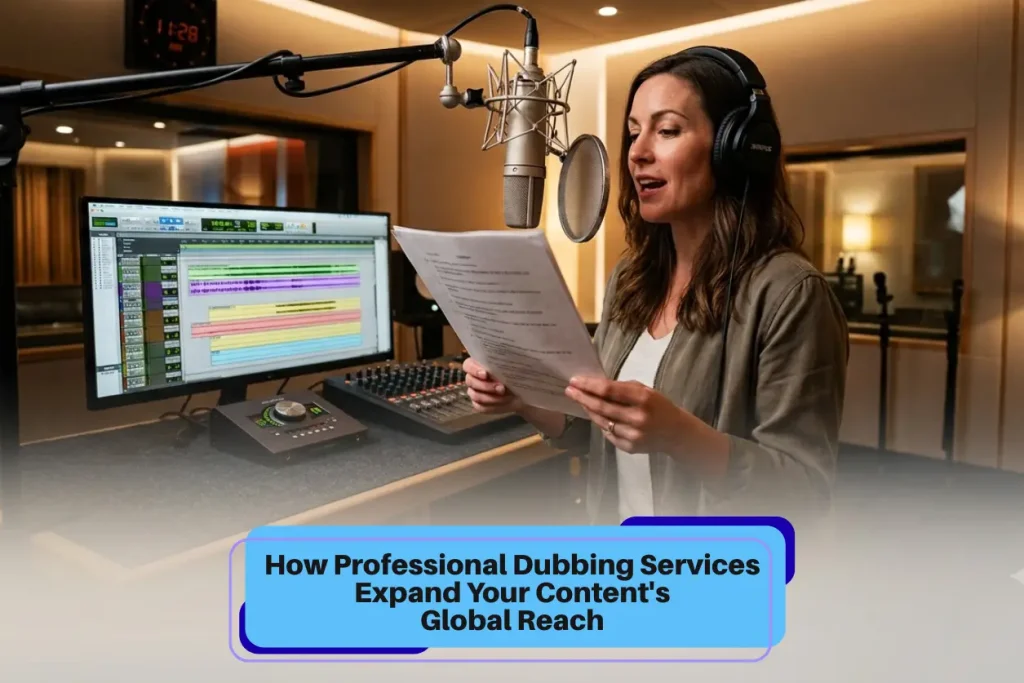
How Professional Dubbing Services Expand Your Content’s Global Reach
Professional dubbing services replace a video’s original audio with a new, natural-sounding recording in another language, allowing films, TV series, and corporate content to be understood and enjoyed by audiences who don’t speak the original language. Rather than relying on subtitles alone, dubbing lets viewers stay fully immersed in the visual elements of a story instead of splitting their attention between reading and watching. For any brand, studio, or platform planning to enter new markets, a professional dubbing company turns a single piece of content into a library of language versions, each one built to feel native rather than translated.
Whether it’s a fast-moving gangster drama, an action-packed spy thriller, or a quiet four-season family series, the emotional impact of a story rarely survives a rushed or robotic translation. That’s where a dedicated dubbing company with an experienced team of dubbing artists, sound engineers, and project managers makes the difference between content that merely gets translated and content that genuinely connects.
Why Professional Dubbing Services Matter for Global Audiences
Dubbing replaces the original speaker’s audio with a new voice recording in the target language, and when it’s done well, viewers forget they’re watching localized content at all. Professional dubbing preserves the original message, the pacing, and the emotional tone of a scene, so a tense confrontation in a gangster drama still feels tense, and a witty exchange in a drama series still lands as funny, regardless of the target language.
This matters because audiences are far more likely to finish and share content that feels like it was made for them. Studies on content localization consistently show that adapting content, not just translating it, has a measurable effect on business results. Localized content builds trust faster than content that visibly reads like a simple translation, and that trust often carries directly into engagement, subscriptions, and sales.
For studios and brands preparing to enter new markets, this is not a cosmetic step. Localization also involves adjusting on-screen text, cultural references, and even visual elements like symbols or colors that don’t translate the same way across cultures. Professional dubbing services are one part of a larger localization services approach that considers the whole viewing experience, not just the words being spoken.
What Goes Into High Quality Dubbing Projects
A dependable dubbing workflow generally includes:
- Script adaptation – adjusting the original script for timing, tone, and cultural relevance in the target language, without sacrificing quality or meaning
- Casting native voice actors – matching voice actors to characters based on tone, age, and vocal style, using native speakers who understand regional nuance
- Lip sync dubbing – timing new dialogue to match on-screen mouth movements for lip-sync dubbing, or timed dialogue replacement for content where strict lip sync isn’t required
- Voice recording – capturing clean, high quality dubbing audio in professional dubbing studios
- Audio post-production – mixing dialogue with original audio elements like music and sound effects for a seamless experience
- Quality assurance – a final review of translation accuracy, audio sync, and overall audio quality before final delivery
This managed workflow is what separates dubbing companies that can handle complex projects at scale from a one-off, freelance approach. When dubbing projects involve multiple languages, tight deadlines, or a long drama series running four seasons, having one team oversee the entire pipeline protects consistency across every episode and every language version.
Foreign Language Dubbing vs. Subtitling: Choosing the Right Fit
Foreign language dubbing and subtitling both help content travel, but they serve different purposes. Subtitles work well when budgets or timelines are tight, or when a target audience is comfortable reading translated narration on screen. Dubbing, on the other hand, removes that reading requirement entirely, which tends to improve watch time and completion rates, especially on streaming platforms where viewers are choosing between dozens of other titles.
Many global brands use both: subtitling fast for early releases or social media clips, and full dubbing for flagship titles going into new markets. The right mix depends on the content type, the target market, and how much a brand wants to prioritize an authentic, native language experience over speed.
Audio Description and Accessibility in Global Languages
Expanding reach isn’t only about language, it’s also about who can access the content at all. Audio description narrates key visual elements, actions, and on-screen text for hard of hearing audiences, blind, and low-vision audiences, making video content genuinely accessible rather than assuming everyone experiences it the same way. Pairing audio description with dubbing in global languages means a single production can reach international audiences across more markets and more ability levels without a separate content strategy for each.
For corporate content, training videos, and educational videos, this combination is increasingly treated as a baseline requirement rather than an add-on, particularly for organizations with global compliance or accessibility obligations.
Dubbing for Explainer Videos, Training Videos, and Corporate Content
Dubbing isn’t reserved for feature films and drama series. Explainer videos, training videos, and internal communications all benefit from multilingual dubbing when a company operates across borders. A single onboarding video or product explainer can be dubbed into multiple languages instead of being reshot for every region, which is far more cost effective and keeps brand voice and messaging consistent across markets.
For corporate content specifically, dubbing helps preserve exceptional communication between global teams. A training video dubbed by native speakers, rather than run through a basic translation, tends to be better understood and better retained, since tone and instructional emphasis translate along with the words.
How Professional Dubbing Services Support SEO and Discoverability
Multilingual video content, when dubbed and properly tagged, also supports search engine optimization in each target market. Platforms and search engines increasingly favor content that’s genuinely localized, since it signals relevance to local audiences rather than a single global upload. Brands that invest in professional dubbing across their video content often see their titles ranked number one or near the top of regional search and platform results, simply because the content was built to be discovered in that language from the start.
Choosing a Dubbing Company for Your Next Project
Not every dubbing company can support every kind of project. Before committing to one, it helps to look at:
- Range of languages – can they cover the multiple languages and global languages your target market requires
- Studio network – do they operate their own dubbing studios or rely entirely on outsourced partners for voice recording
- Talent pool – do they have a deep bench of dubbing artists and voice actors, or a narrow list that gets reused across every genre
- Workflow transparency – is there a clearly managed workflow from script to final delivery, with quality assurance built in at each stage
- Track record with complex projects – have they handled multi-season drama series, franchises, or ongoing dubbing projects rather than one-off jobs
DUBnSUB works across these exact requirements as a professional dubbing company built around native speakers and an experienced team, rather than shortcuts that sacrifice quality for speed. From a single explainer video to an ongoing drama series spanning four seasons, the focus stays on preserving the original message while adapting it naturally for each target language. With dubbing studios and a global partner network supporting projects in global languages, along with audio description services for accessibility, DUBnSUB helps content creators and brands provide dubbing that holds up to close listening, not just a quick check of the box, all at competitive rates and without compromising quality or blowing through tight deadlines.
Frequently Asked Questions (FAQs)
1. What is the difference between dubbing and voice-over?
Dubbing replaces the original audio entirely and syncs new dialogue to the speaker’s lip movements, making it the standard for films, animation, and drama series. Voice-over layers a translated narration over the original audio, which is often faintly audible underneath, and suits documentaries or corporate content where strict lip sync isn’t essential. DUBnSUB provides both professional dubbing and voice-over services, recommending the right format based on the content type and target audience.
2. Can dubbing really replace subtitles for reaching global audiences?
Dubbing and subtitling aren’t strictly interchangeable; each fits different budgets, timelines, and audience habits. Dubbing tends to improve immersion and completion rates since viewers aren’t reading on-screen text, while subtitling fast remains useful for quick turnarounds. DUBnSUB helps brands decide which approach, or combination, best serves their target market and project requirements.
3. How long does a typical dubbing project take?
Timelines depend on video length, number of languages, and project complexity, but a standard dubbing workflow includes script adaptation, casting, voice recording, and audio post-production before final delivery. DUBnSUB’s managed workflow and global studio network allow the team to accommodate tight deadlines without compromising quality, even across multiple languages at once.
4. Does professional dubbing work for corporate and training videos, not just entertainment?
Yes, dubbing is widely used for training videos, explainer videos, and internal communications wherever a company operates across multiple regions. It keeps tone, instructional emphasis, and brand voice consistent across every language version. DUBnSUB regularly handles corporate content and educational videos for global teams, in addition to entertainment and streaming platform projects.
5. What makes dubbing “high quality” rather than a simple translation?
High quality dubbing goes beyond simple translation by adapting scripts for timing, tone, and cultural relevance, then pairing that with native voice actors and careful audio post-production. The goal is to preserve the original message and emotional intent, not just the literal words. DUBnSUB’s quality assurance process reviews translation accuracy and audio quality at every stage before a project reaches final delivery.
6. Can dubbing services also make content accessible to hard of hearing audiences?
Dubbing itself addresses language barriers, but accessibility for hard of hearing audiences typically requires audio description or captioning alongside it. Audio description narrates key visual elements and on-screen text for audiences who can’t see the screen clearly, while captions serve those who can’t hear it. DUBnSUB offers audio description services in addition to dubbing, helping content reach both new audiences and audiences with different accessibility needs.
7. How do I choose the right dubbing company for an ongoing project, like a multi-season series?
Look for a company with a genuinely managed workflow, a deep talent pool of dubbing artists across languages, and a track record with complex, multi-season projects rather than one-off jobs. Consistency across seasons and episodes matters as much as the quality of any single recording. DUBnSUB supports long-running dubbing projects, including multi-season drama series, with the same experienced team and quality standards from the first episode to the last.