
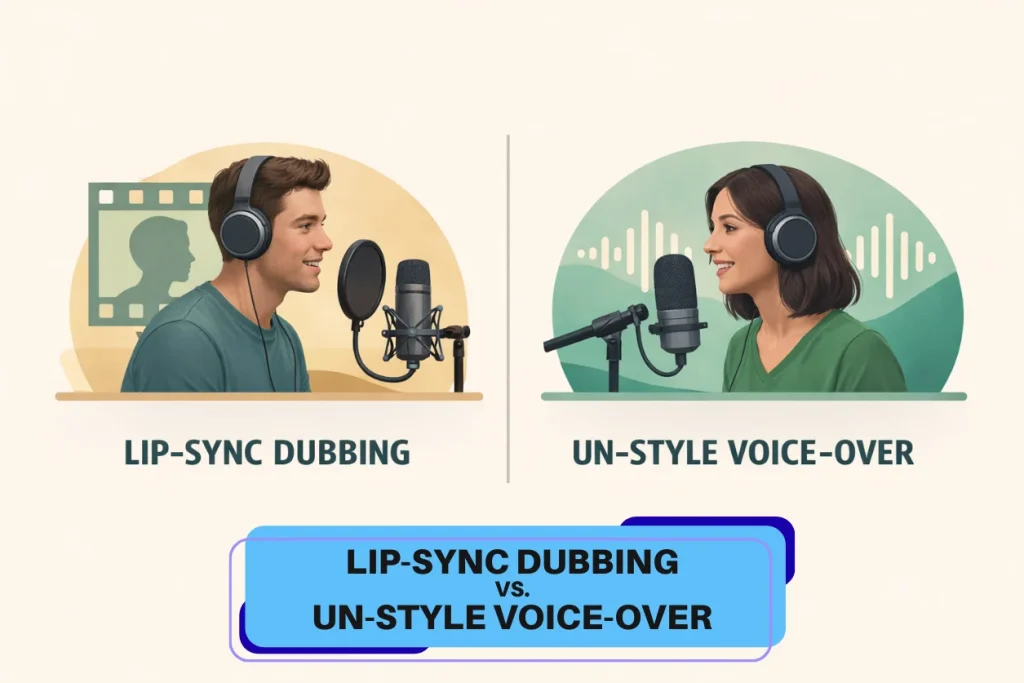
Lip-Sync Dubbing vs. UN-Style Voice-Over: What’s the Right Choice for Your Project?
When choosing between lip-sync dubbing and UN-style voice-over dubbing for your video content, the decision comes down to the nature of your project, your target audience, and the level of cinematic immersion you need. Lip-sync dubbing fully replaces the original dialogue with a translated audio track engineered to match the speaker’s mouth movements, making it the gold standard for feature films, animated series, and OTT content. UN-style voice-over keeps the original audio playing at a low volume while a translated voice is layered over it, recorded off camera — widely used for documentaries, news segments, educational content, and training videos. Both are powerful content localization strategies when applied to the right type of content, and both are core services at DUBnSUB.
What Is Lip-Sync Dubbing?
Lip-sync dubbing — also called lip syncing — is the process of replacing original dialogue with newly recorded translated audio that closely mirrors the lip movements of the on-screen speaker. Professional voice actors study the timing, rhythm, and mouth movements of the original performance to deliver translated dialogue that feels native to the target audience.
For lip sync dubbing to work effectively, the translated script must be carefully adapted — not merely translated word for word. The words need to fit the timing of the speaker’s mouth movements, and the emotional nuance of the original performances must be preserved. The new audio track must feel seamless against the visual, creating full cinematic immersion for diverse audiences watching in their native language.
Lip-sync dubbing is the benchmark for feature films, animated content, OTT drama series, branded entertainment, and video game cut-scenes — any content where character-driven storytelling and emotional resonance are central to the experience.
What Is UN-Style Voice Over Dubbing?
UN-style voice over dubbing takes a different approach. The original audio remains in the background at low volume while a translated voice is overlaid — recorded off camera without the need to sync with mouth movements. This method is named after the format used in United Nations broadcasts, where an interpreter’s voice overlays the original speaker.
Because the voice is recorded off camera and does not require lip sync alignment, the translator has greater flexibility with the translated dialogue. This allows for a more accurate, literal translation rather than an adapted one. Audiences can still faintly hear the original tone of the original speaker beneath the overlay, which can strengthen the perceived authenticity of the content — particularly useful in documentary and interview formats.
UN-style voice over is widely used for documentaries, news segments, corporate training videos, medical explainer videos, educational content, conference recordings, and interview-based programming. It offers faster turnaround and is more budget-friendly than full lip-sync, without compromising reach or clarity.
Lip Syncing vs. UN-Style: Understanding the Core Differences in Dubbing and Voice
The fundamental difference between these two approaches lies in the relationship between the audio track and the visual performance, and how much the audience is meant to forget they are watching a translation.
With lip sync dubbing, the new audio is engineered to fully replace the original audio. Viewers hear only the translated version, with mouth movements aligned to make the experience indistinguishable from original-language content. With UN-style, the original audio remains — faintly audible — beneath the translated voice. Viewers are aware they are hearing a translation, but the focus is on information delivery rather than character immersion.
Here’s a quick comparison to help guide your content strategy:
| Lip-Sync Dubbing | UN-Style Voice-Over | |
| Original Audio | Replaced entirely with new audio | Original audio playing at low volume |
| Script Adaptation | Timed to match lip movements | Literal translation acceptable |
| Voice Actors | Character-matched, emotive | Neutral, clear off camera delivery |
| Best For | Films, animation, OTT, games | Docs, interviews, training, news |
| Production Time | Longer, more post production | Faster turnaround |
| Cost | Higher investment | More budget-friendly |
When Lip-Sync Dubbing Powers Your Content Creation
If your content creation goals involve reaching global audiences through streaming platforms, theatrical releases, or branded entertainment, lip-sync dubbing is the stronger choice. When viewers watch a drama series, an animated film, or high-production brand video content in a different language, full lip sync removes language barriers and creates a truly native viewing experience.
Lip-sync dubbing works best when:
- Emotional connection between the viewer and on-screen characters drives engagement
- You’re distributing scripted video content across multiple languages on OTT or theatrical platforms
- Your content strategy prioritizes long-term audience retention and brand immersion
- You need the translated audio to sound natural and indistinguishable from original content
- The project involves voice actors delivering character-specific emotion and voice
A social media manager running multilingual YouTube videos, a studio releasing feature films in new territories, or a brand producing campaigns for diverse audiences — all benefit from the investment in professional lip-sync dubbing.
When UN-Style Voice-Over Best Serves Your Global Audiences
For content where information clarity matters more than character immersion, UN-style voice over dubbing delivers excellent results. Educational content, corporate training videos, documentaries, and interview-driven formats all suit this approach — especially when the original speaker’s credibility and original tone are part of the message.
UN-style voice over works best when:
- The audience needs to trust the original speaker’s voice, even heard faintly
- Content is factual, instructional, or informational
- Turnaround time is a priority in your production schedule
- Budget constraints require a cost-effective solution without reducing your reach
- The format — news segments, conference recordings, educational content — naturally accommodates a translation overlay
Medical explainer videos, corporate training programs, documentary series, and educational content on platforms like Coursera or LinkedIn Learning all fall naturally into the UN-style category. Human translators working in this format can also ensure that cultural references and technical terminology are handled with precision in the target language.
Inside the Dubbing Studio: Where Quality Is Delivered
Regardless of the style you choose, the quality of your final audio track is determined by what happens inside the dubbing studio. Professional voice actors, skilled sound engineers, linguistically accurate translators, and experienced dubbing directors all contribute to the final output.
A professional dubbing studio ensures the translated dialogue sounds natural in the target language, that cultural references are appropriately adapted, and that the emotional resonance of the original content is preserved. Whether it is a UN-style overlay or a full lip sync replacement, studio expertise is what separates professional-grade localization from a rough translation. The original performances must be matched with the right voice — in energy, tone, and pacing — to create a better understanding for the new audience.
A Note on AI Dubbing and Dubbing AI Tools
AI dubbing and dubbing AI tools have become more visible in video content localization in recent years. Automated dubbing tool platforms and AI voices can generate rough translated audio for video files quickly, and some offer approximate lip syncing for social media and low-stakes content.
However, AI dubbing at its current stage struggles to replicate the emotional nuance, tonal accuracy, and cultural sensitivity that professional voice actors bring. Voice cloning technology has improved, but the gap between AI voices and human performance becomes most apparent in scripted drama, branded content, and any video where the audience’s emotional response matters. For content where quality, accuracy, and brand credibility are non-negotiable, human-led dubbing and voice over remain the professional standard. AI can support workflows — but it is not a replacement for craftsmanship.
Frequently Asked Questions
1. What is the main difference between lip-sync dubbing and UN-style voice-over?
Lip-sync dubbing fully replaces the original audio with a translated audio track engineered to match the speaker’s mouth movements. UN-style voice-over keeps the original audio playing at low volume while a translated voice is layered over it, recorded off camera — with no need to sync with lip movements. Lip-sync creates full immersion; UN-style preserves the original speaker’s presence and suits informational content.
At DUBnSUB, we offer both styles across 100+ languages. Our teams handle script adaptation, professional voice actors, and full studio recording — so you get the right format with the right quality, every time.
2. Which dubbing style is better for OTT platforms like Netflix or Amazon Prime?
Lip-sync dubbing is the standard for OTT drama, animation, and scripted content where cinematic immersion is central to the viewer experience. UN-style is commonly used for documentary and factual programming on the same platforms.
DUBnSUB has delivered both styles for OTT clients across multiple languages, with quality standards and common formats aligned to the technical specifications of major streaming platforms.
3. Is UN-style voice-over cheaper than lip-sync dubbing?
Yes — UN-style voice over is generally more affordable because it does not require script timing adaptation to match lip movements. The recording process is faster, and it involves less post production work, making it a smart choice for high-volume or budget-conscious projects.
DUBnSUB offers competitive pricing for both styles. Our team can advise on the most cost-effective approach based on your content type, target language, and distribution goals.
4. Can AI dubbing replace professional voice actors?
AI dubbing tools can handle basic, low-stakes content quickly, but they fall short on emotional nuance, tonal accuracy, and cultural adaptation. For content where audience connection, original tone, and brand reputation matter, professional voice actors remain essential. The difference is most evident in scripted drama, children’s animation, and high-visibility brand content.
DUBnSUB uses a human-led workflow for all dubbing and voice projects — ensuring every translated audio track sounds natural, culturally accurate, and true to the original tone of the source material.
5. How do I choose the right dubbing style for training videos or educational content?
For educational content and corporate training videos, UN-style voice over is typically the right choice. It is faster to produce, more affordable, and fits naturally within formats where the audience expects clear, informational delivery rather than character immersion. It also allows for more precise, literal translation of technical or instructional language.
DUBnSUB handles e-learning and training video localization at scale — offering UN-style voice over in 100+ languages with fast turnaround, consistent quality, and native-speaking voice professionals across all target languages.
6. What languages support professional lip-sync dubbing?
Professional lip-sync dubbing can be delivered in virtually any language, though some languages present greater adaptation challenges due to sentence length and phonetic structure relative to English. Experienced studios adapt scripts carefully to maintain sync quality and natural delivery across diverse audiences.
DUBnSUB offers lip-sync dubbing in 100+ languages, with native-speaking professional voice actors and skilled adaptation writers ensuring output quality across every language combination.
7. How long does lip-sync dubbing take compared to UN-style voice-over?
Lip-sync dubbing typically takes longer due to script adaptation, voice casting, studio recording sessions, and post production sync work. Depending on language complexity and content length, a 30-minute project can take several days to a week. UN-style voice over can often be turned around in a shorter timeframe given its simpler production pipeline.
DUBnSUB provides clear, upfront timelines for both services — and for clients with tight deadlines, our team can prioritize without compromising the quality of the final audio output.
Need help deciding which style fits your project? Contact DUBnSUB today for a free consultation and quote: https://dubnsub.com/