
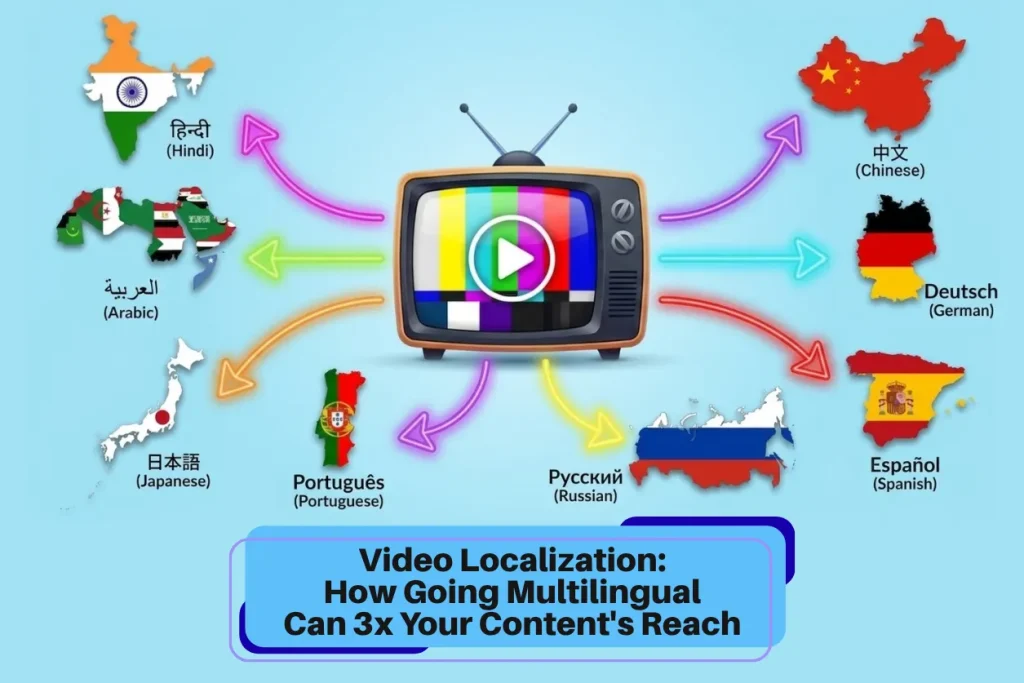
Video Localization ROI: How Going Multilingual Can 3x Your Content’s Reach
Video localization ROI refers to the measurable return a brand or content creator earns by adapting their video content — through dubbing, subtitle translation, and cultural adaptation — for audiences in multiple languages and regions. When you localize a single piece of video content into three or more languages, you are not just translating words; you are multiplying distribution potential, unlocking new markets, and extending the life of every piece of audiovisual content you produce. Research consistently shows that audiences engage longer, convert higher, and trust more when video speaks to them in their primary language — which is why going multilingual can realistically triple your content’s reach, viewership, and downstream revenue.
Why Video Localization Is a Growth Strategy, Not Just a Translation Task
Most brands treat video translation as a box to tick at the end of a marketing campaign. The smarter approach treats it as a growth lever from the start.
When you invest in localized video content, you are making your spoken dialogue, on screen text, subtitles and captions, and audio descriptions accessible to entirely new target audiences — people who would otherwise scroll past your content or drop off within seconds. The math is straightforward: a single training video localized into five languages does not cost five times what one version costs, but it can reach five times the audience.
Video localization workflows today cover everything from script translation and voice over recording to dubbed audio tracks, translated subtitles, closed captions, and even cultural adaptation of visual elements. Each of these layers adds depth to how a global audience receives and retains your message.
Dubbing Videos vs. Subtitles: Understanding the Key Differences
One of the first decisions in any localization project is whether to dub or subtitle — or both. The key differences come down to viewer experience, content type, and budget.
Subtitles and captions display translated text at the bottom of the original video. They preserve the original audio while making content accessible to viewers in a different target language, as well as hard of hearing audiences. Subtitle translation services are typically faster to produce and cost effective for content with lower production budgets. A translated subtitle file can be delivered in multiple subtitle formats for different social media platforms and streaming services. Subtitle translation is also excellent for content where the original language carries brand authority — think CEO interviews or expert commentary.
Dubbing replaces the original audio entirely with a translated voice track in the target language. Professional dubbing involves skilled voice actors recording a translated transcript that matches the timing and, where needed, the lip movements of the original dialogue. This creates a seamless viewing experience where the audience never has to read while watching. Dubbing is the preferred choice for entertainment, e-learning, product demos, and marketing campaigns where immersion matters.
For maximum ROI, many brands deploy both: dubbed audio tracks for primary markets and translated captions or subtitle files for secondary audiences.
Where AI Dubbing Fits Into Professional Video Localization Workflows
The emergence of AI dubbing has meaningfully changed the economics of video localization — but it is important to understand where it adds value and where human expertise remains irreplaceable.
An AI dubbing tool can accelerate early-stage tasks: generating a translated transcript from the original video, auto-producing a draft ai voice track, and flagging timing mismatches between the translated text and the original dialogue. Some platforms allow you to upload your video, select a target language, and receive a draft dubbed audio track within hours.
However, a responsible AI dubbing platform treats these outputs as a starting point, not a final product. Machine translation, for instance, can produce technically accurate translated text but often misses idiomatic expressions, cultural references, and the tonal nuance that makes a voice over feel natural. AI-powered dubbing works best when it is used to compress timelines — handling first-draft script translation and initial audio files — while experienced linguists and sound engineers handle the review, timing adjustments, and final output.
The risk of going fully automated without expert human review is significant. Mistranslated cultural context, a mismatch between the ai voice and the brand’s tone, or incorrect timing in the translated voice track can undermine viewer trust far more than simply not localizing at all. The right ai dubbing platform integrates automation with professional oversight — not as a replacement for it.
Auto Generate Subtitles: Speed Is Not the Same as Accuracy
Many video platforms now offer the ability to auto generate subtitles directly from your video files. This is a useful starting point for accessibility and SEO — search engines can index translated captions, and auto-generated subtitles make content accessible to hard of hearing audiences without a long production timeline.
But automatically generated subtitle files carry well-documented accuracy issues, particularly for technical content, multiple speakers, heavy accents, or specialized terminology. A subtitle block placed at the wrong timestamp, or a mistranslation in closed captions for a medical training video, is not just an inconvenience — it is a liability.
For training videos, product demos, legal content, and any video where precision matters, auto-generated outputs should always be reviewed by a professional subtitle translation service before publication. The goal is to use automation to reduce hours, not to eliminate human judgment.
How to Maintain Quality Across Audio Files and Multiple Languages
Scaling video localization across multiple languages introduces real quality control challenges. Maintaining consistent brand voice, accurate spoken content, and synchronized audio files becomes harder as volume increases.
The key to maintaining quality at scale is a structured workflow. Source video and audio files should be shared with the localization team in full — not just a script. Sound effects, background audio, and original dialogue all affect how the translated video sounds. Voice actors need context from the original video to match tone and energy, not just the translated text.
Expert human review at every stage — translation, voice recording, and final audio mixing — is what separates professional video localization services from fast, cheap alternatives. When the final output goes out in your brand’s name, the quality of every dubbed audio track and every subtitle file reflects directly on your credibility.
Real-World ROI: Product Demos, Training Videos, and Ad Campaigns
Where does the ROI actually show up? Three content types deliver the clearest returns from video localization.
Product demos localized into the buyer’s own language consistently generate higher conversion rates. When a prospective customer in Tokyo, São Paulo, or Berlin watches your product demo with a natural-sounding dubbed audio track and localized on screen text, the purchase friction drops significantly. Video translation services that handle both the spoken dialogue and the visual elements give product videos their highest possible impact.
Training videos are another area of clear ROI. Global teams that train on localized videos retain information better and complete modules at higher rates than those relying on subtitles or unlocalized content. For organizations rolling out compliance training, software onboarding, or health and safety content across multiple languages, localized video is not an optional extra — it is an operational necessity.
Ad campaigns that run localized versions across social media platforms consistently outperform single-language campaigns in international markets. A culturally adapted video — with proper voice cloning process oversight or native voice actors, accurate translated captions, and culturally resonant messaging — builds brand trust that a generic translated video simply cannot.
The Bottom Line: Localization Is Your Content Multiplier
Creating great video content in one language and stopping there is leaving a substantial portion of your potential audience unreached. Video localization — done properly, with professional translation, skilled voice actors, accurate subtitle files, and structured quality control — is the clearest path to multiplying the reach and commercial impact of every piece of content you produce.
The investment required to localize a video into three to five languages is a fraction of what it costs to create new content from scratch. The return — in reach, engagement, conversion, and brand trust across global markets — consistently justifies that investment many times over.
Whether you are starting with subtitle translation for a handful of social media videos or building a full multilingual dubbing pipeline for training videos and product demos, the time to localize is before your competition does it first.
Creating great video content in one language and stopping there is leaving a substantial portion of your potential audience unreached. Video localization — done properly, with professional translation, skilled voice actors, accurate subtitle files, and structured quality control — is the clearest path to multiplying the reach and commercial impact of every piece of content you produce.
The investment required to localize a video into three to five languages is a fraction of what it costs to create new content from scratch. The return — in reach, engagement, conversion, and brand trust across global markets — consistently justifies that investment many times over.
Whether you are starting with subtitle translation for a handful of social media videos or building a full multilingual dubbing pipeline for training videos and product demos, the time to localize is before your competition does it first.
Frequently Asked Questions (FAQs)
1. What is the difference between dubbing and voice over in video localization?
Dubbing replaces the original audio entirely with a new translated voice track that is synchronized to the video, often matching the lip movements of on-screen speakers. Voice over, by contrast, typically plays alongside or slightly under the original audio — the original language is often still faintly audible. Dubbing is preferred for entertainment and high-immersion content, while voice over suits corporate videos, documentaries, and e-learning where a direct translated narration is sufficient.
At DUBnSUB, both services are available across 100+ languages, with a team of 3,200+ native voice actors who ensure that whether you need full dubbing or voice over, the final audio track sounds natural and brand-consistent.
2. Can machine translation be used for professional video localization?
Machine translation can handle first-draft script translation quickly and cost-effectively, and it has improved significantly in recent years. However, it tends to struggle with cultural nuance, idiomatic language, and the lip-sync timing requirements of dubbing. For professional video content — especially product demos, training videos, and ad campaigns — machine translation outputs should always be reviewed and refined by native-language professionals before recording.
DUBnSUB uses a structured workflow where machine translation is a tool for efficiency, not the endpoint. Every translated script goes through expert human review by native linguists before voice actors record the final dubbed audio track.
3. How do I choose between subtitles and dubbing for my video content?
The right choice depends on your audience, content type, and budget. Subtitles are faster, more cost-effective, and work well for news content, interviews, and situations where the speaker’s original voice carries authority. Dubbing delivers higher viewer retention and engagement, making it better suited for entertainment, e-learning, and marketing content where immersion drives results. Many brands use both: dubbing for primary markets and subtitle translation services for secondary audiences.
DUBnSUB offers end-to-end video localization services covering both dubbing and subtitling in 100+ languages, so you can mix and match based on what each market requires.
4. What should I look for in a video localization partner to maintain quality?
Look for a provider that combines native-speaking linguists, professional voice actors, and qualified sound engineers in a structured post-production workflow. Quality control checkpoints — covering translation accuracy, voice recording, lip-sync precision, and audio mixing — are non-negotiable for localized video content that represents your brand internationally. Avoid services that rely entirely on automated tools without expert human review at critical stages.
DUBnSUB follows a multi-stage quality control process from script translation through final audio delivery, with dedicated production managers overseeing every project across its global network of 200+ dubbing studios.
5. How does video localization impact SEO and discoverability?
Localized video content improves discoverability in multiple ways. Translated captions and subtitle files can be indexed by search engines, expanding your organic reach in target-language searches. Localized videos that match a viewer’s preferred language also reduce bounce rates and increase watch time — both signals that search and social media platforms use to determine content quality and ranking. Product demos, training videos, and social media content that speak to viewers in their own language consistently outperform unlocalized equivalents on engagement metrics.
DUBnSUB’s subtitle translation services deliver subtitle files in multiple formats ready for upload across major social media platforms and streaming services, ensuring your localized video content is fully discoverable from day one.
6. Is AI dubbing reliable enough for professional content?
AI-powered dubbing has become a genuine accelerator for video localization workflows — it can dramatically reduce timelines for generating a first-draft translated voice track from original audio. However, ai dubbing works best as a productivity layer within a professional workflow, not as a standalone solution. For content where brand voice, accuracy, or cultural sensitivity matters — which is most professional content — the ai voice output needs to be reviewed, adjusted, and often re-recorded in part by native voice actors.
DUBnSUB integrates AI-assisted tools within its localization workflows to improve speed and scalability, while ensuring every final output meets the quality standards expected from a professional dubbing studio.