
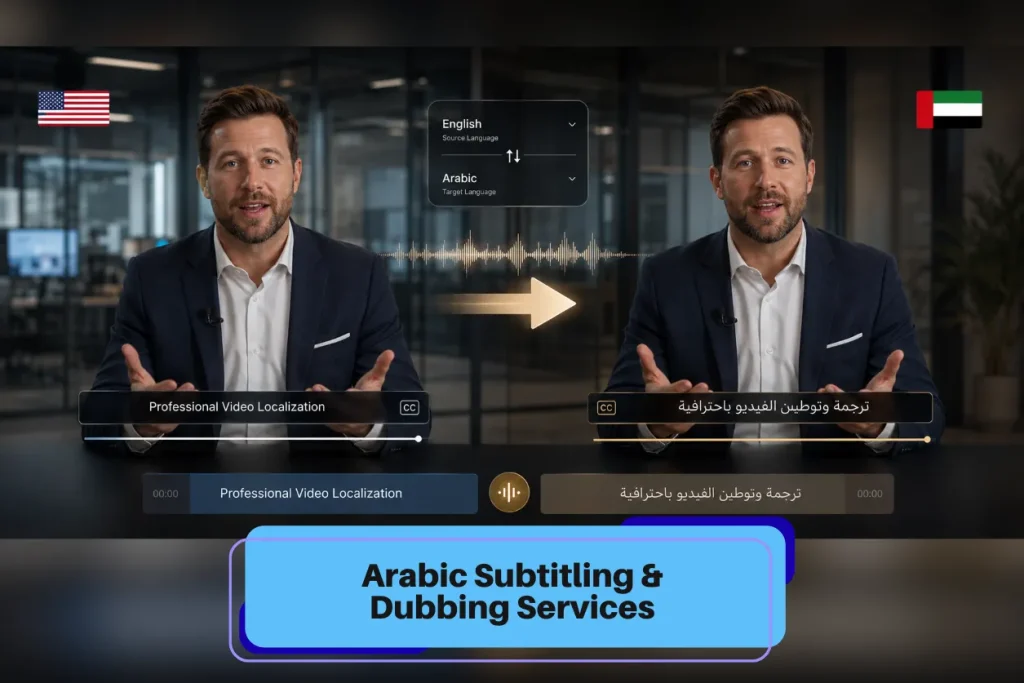
Arabic Subtitling & Dubbing: What Makes Middle East Localization Different
Arabic subtitling and dubbing for the Middle East is a specialized discipline that goes far beyond straightforward translation. It involves navigating a diverse region with over 25 Arabic-speaking countries, multiple distinct dialects, a right-to-left script, deep-rooted cultural nuances, and audiences with very specific expectations around voice, tone, and on-screen presentation. Whether you are a brand expanding into the Middle Eastern market, an OTT platform targeting new arabic speakers, or a game studio planning a regional launch, understanding what makes Arabic localization services unique is the first step to getting it right.
Why the Arabic Language Is Uniquely Complex to Localize
Arabic is one of the world’s oldest and most widely spoken languages — recognized as an official language by the United Nations and spoken by more than 400 million people globally. It is written right-to-left, uses a distinct alphabet, and has a significant gap between its formal written form and everyday spoken varieties.
Modern Standard Arabic (MSA) serves as the standardized written form used in formal documents, news broadcasts, and official communication across arabic speaking countries. However, it is rarely the language people use in daily conversation. This distinction is critical in multimedia localization: using MSA for a street-level drama set in Cairo will ring hollow to Egyptian audiences, just as Egyptian Arabic would feel out of place in a Gulf-produced corporate video. Skilled translators working on arabic translation projects must be well versed in both registers — knowing when to use which, and why it matters to the target audience.
This dual reality of the arabic language means that effective communication depends not just on linguistic accuracy, but on deeply contextual judgment. No generic translation services provider can deliver this without native speakers and subject matter expertise at the core of the process.
Arabic Dialects: The Make-or-Break Factor in Localization
One of the most common mistakes brands make when entering the Middle East is treating Arabic as a single, uniform language. In reality, arabic dialects vary dramatically from one region to another. Egyptian Arabic, Gulf Arabic, Levantine Arabic, Maghrebi Arabic, and Iraqi Arabic are among the major regional variations — and each carries its own vocabulary, pronunciation, rhythm, and cultural weight.
For video content intended to connect with a specific regional audience, dialect selection is a critical localization decision. A brand producing arabic dubbing for Saudi Arabia needs a Gulf voice; a streaming platform targeting North Africa requires Maghrebi sensibility. Getting this wrong does not just reduce engagement — it signals cultural disconnection, which audiences immediately notice.
This is why reputable arabic localization services providers build their teams around native speakers from different dialects and regions, rather than relying on a one-size-fits-all approach to the arabic language. Different dialects demand different translators, different voice artists, and often different creative choices in adaptation.
What Goes Into Professional Arabic Subtitling Services
Arabic subtitling services involve a layered process that goes well beyond typing translated words onto a screen. There are several critical technical and linguistic factors involved:
Right-to-left text rendering is a non-negotiable requirement. Arabic text flows from right to left, which means subtitle files — including common formats like the srt file — must be configured to display correctly across different players and platforms. Incorrect rendering can make subtitles appear garbled or misaligned, breaking viewer immersion entirely.
Character limits and reading speed work differently in Arabic. The language uses connected script and often expresses in fewer words what requires more in English. A subtitle team working on arabic translation must adapt timing and condensation strategies specifically for Arabic — not just translate from English word for word.
Cultural nuances in on-screen language are equally important. Idioms, humor, religious references, and honorifics that exist in the source language often have no direct equivalent in Arabic, or need to be reframed for a Middle Eastern audience. Translators must localize the meaning and intent, not merely the words.
Across all these requirements, quality arabic subtitling services depend on native-speaking linguists who understand both the target language and the cultural context — not just bilingual translators working from a dictionary.
Arabic Dubbing: Voice, Tone & Cultural Fit
Arabic dubbing adds another dimension of complexity to the localization process. Beyond translation, it requires selecting voice artists whose tone, register, and dialect match the intent of the original content and the expectations of the target audience.
In arabic dubbing, lip-sync is technically demanding. Arabic words and sentence structures often differ significantly in length and rhythm from English scripts, which means adapters must rewrite lines to match mouth movements while preserving meaning and natural delivery. This requires experienced dubbing writers who are well versed in both languages — and in the specific dialect being produced.
Cultural fit is equally essential. A children’s animation requires warm, playful voices suited to young Arabic speakers. A corporate training video needs authoritative, professional delivery. A dramatic film demands emotional authenticity. The wrong voice — even if technically accurate — will undermine the entire production.
Voice casting for the Middle East also involves nuanced decisions: Gulf Arab audiences, for instance, have distinct preferences around formality and tone compared to audiences in the Levant or North Africa. A translation company that understands the middle east as a diverse region — rather than a single monolithic market — will make better casting decisions at every step.
Beyond Audio: Graphics Localization & Game Localization for Arabic Audiences
Comprehensive arabic localization services cover much more than subtitles and voiceover. Graphics localization is an essential part of the process — adapting on-screen text, UI elements, infographics, lower-thirds, and branded visuals to work correctly in Arabic layout and formatting.
Because Arabic is read right-to-left, entire interface layouts often need to be mirrored. Buttons, menus, and text-heavy design elements must be restructured — not just translated. For global marketing materials entering the Middle Eastern market, overlooking graphics localization can make content appear unprofessional or inaccessible, regardless of how strong the audio translation is.
Game localization for Arabic audiences presents similar challenges. Arabic speakers represent a fast-growing and highly engaged gaming audience. Localizing a game for the middle east means adapting not just dialogue and subtitles, but also in-game text, menus, tutorials, and culturally sensitive imagery. Effective game localization ensures the full gaming experience feels native — from the first menu screen to the final cutscene.
Choosing the Right Translation Company for Middle East Localization
Entering the Middle Eastern market through localized content is a strategic investment — and it requires a translation company that combines linguistic depth, regional expertise, and multimedia localization capabilities under one roof.
The right partner for arabic translation projects will have native-speaking translators and voice artists covering the major dialect groups, a clear process for quality assurance, and experience across entertainment, e-learning, gaming, and corporate video content. Subject matter expertise matters too: medical content, legal scripts, and technical documentation each require translators who understand the field, not just the language.
DUBnSUB is a globally recognized audiovisual localization agency with extensive experience delivering arabic subtitling services, arabic dubbing, graphics localization, and game localization for clients targeting Arabic speakers across the Middle East and beyond. With a network of over 10,000 native linguists and 3,200+ voice artists, DUBnSUB brings the dialect knowledge, cultural understanding, and multimedia production expertise needed to localize content that truly resonates. Whether you need a single srt file delivered quickly or an end-to-end localization rollout across the region, DUBnSUB offers the scale and quality to support your global audiences strategy.
Frequently Asked Questions (FAQs)
1. What is the difference between Modern Standard Arabic and regional dialects in localization?
Modern Standard Arabic (MSA) is the formal, written variety of Arabic used in official documents, news media, and educational content across arabic speaking countries. Regional dialects — such as Egyptian, Gulf, or Levantine Arabic — are the spoken varieties people use in everyday life. For most video content, drama, and entertainment, dialect-appropriate language connects better with the target audience.
When you work with DUBnSUB, our translators and voice artists are well versed in both MSA and the relevant regional dialect for your project. We assess your content type and target market to recommend the right language register — whether that means formal narration in MSA or authentic regional delivery for maximum audience connection.
2. Do I need separate arabic subtitling services for different Arab countries?
Not always — but it depends on your content and audience. For general-audience video content, MSA subtitles can work across most arabic speaking countries. For entertainment, social media, or localized marketing, dialect-specific subtitles create much stronger engagement with your target audience in a specific region.
DUBnSUB offers both MSA and dialect-specific arabic subtitling services, with native speakers handling each regional variation. Our team can advise on the most cost-effective approach for your distribution strategy — whether you are targeting a single market or localizing for global audiences across the diverse region.
3. Why does the right-to-left script create technical challenges for Arabic subtitling?
Arabic script runs from right to left, which affects how subtitle files render across video players and platforms. Formats like the srt file must be correctly encoded and configured to display Arabic without text misalignment or garbling. Additionally, Arabic typography connects letters differently based on their position in a word, making font selection and text rendering critical for on-screen clarity.
DUBnSUB’s technical team is experienced with all standard subtitle formats and handles RTL language requirements precisely. Every arabic subtitling project goes through quality control to ensure correct display across platforms before delivery.
4. How are arabic dialects handled in dubbing projects?
In arabic dubbing, dialect selection is one of the first and most important creative decisions. The wrong dialect — even with perfect translation — can make dubbed content feel foreign or inauthentic to the audience. Voice casting, script adaptation, and lip-sync all need to align with the specific dialect chosen for the target region.
DUBnSUB maintains a talent pool of over 3,200 native arabic voice artists spanning all major dialect groups — Gulf, Egyptian, Levantine, Maghrebi, and others. Our casting process matches voice artists not just by language, but by regional accent, tone, and the emotional register your content requires.
5. What does graphics localization involve for Arabic content?
Graphics localization means adapting all visual text elements — titles, lower-thirds, infographics, UI overlays, and branded graphics — into Arabic, including correct RTL layout and formatting. Because Arabic reads right-to-left, entire graphic layouts often need to be restructured, not just translated. Skipping this step can make even well-dubbed or subtitled content look unprofessional.
DUBnSUB provides full graphics localization as part of our arabic localization services, ensuring that every visual element of your content is adapted correctly for Arabic-speaking audiences — from broadcast productions to digital marketing videos.
6. Is game localization for Arabic audiences significantly different from other markets?
Yes. Game localization for the Middle East involves adapting not just written text but also UI direction, in-game menus, dialogue, and sometimes visual elements for cultural appropriateness. Arabic is an official language in a region with a rapidly growing gaming audience, and players have increasingly high expectations for quality localization.
DUBnSUB’s game localization team combines linguistic expertise with gaming industry knowledge. We handle everything from script translation and voice-over casting to UI text adaptation — ensuring your game feels fully native to Arabic speakers rather than a translated afterthought.
7. How do I know if a translation company has genuine expertise in Middle East localization?
Ask about their team’s native language coverage, dialect capabilities, experience with multimedia localization formats (not just document translation), and whether they have delivered projects specifically for the Middle Eastern market. Subject matter expertise, quality assurance processes, and a portfolio of completed projects are all strong indicators.
DUBnSUB has been delivering arabic translation, arabic dubbing, and arabic subtitling services to global brands, OTT platforms, and media companies for years. With offices in multiple countries and a team of native-speaking translators, voice artists, and localization specialists, we are built to be the translation company partners rely on when the Middle East is the market that matters.
Ready to localize your content for Arabic-speaking audiences? Contact DUBnSUB to discuss your project and get a custom quote tailored to your language, dialect, and format requirements.