
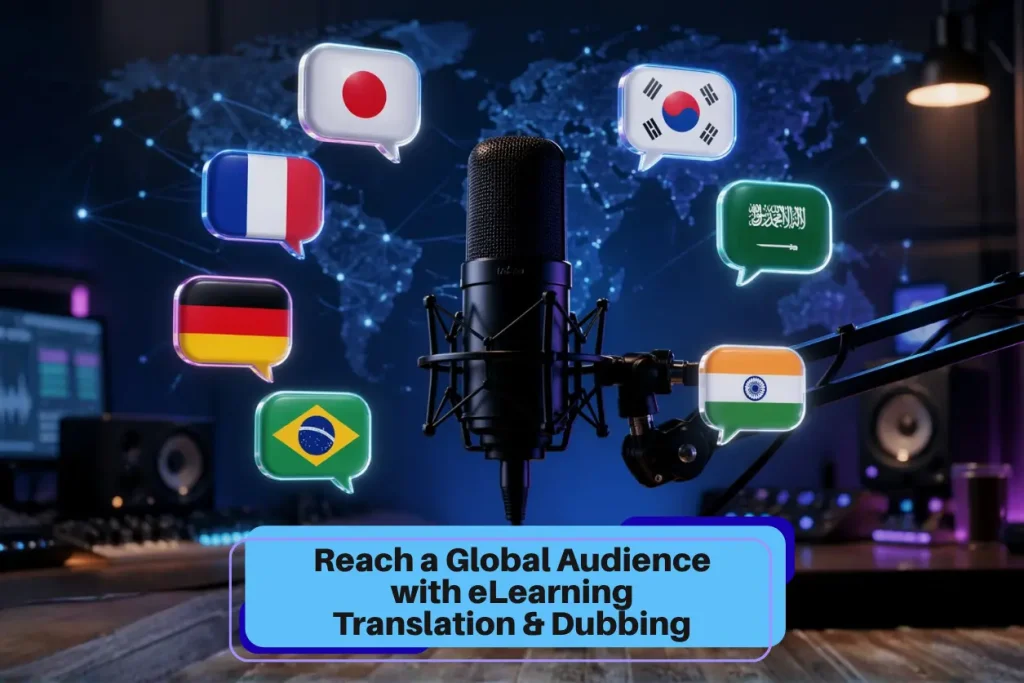
Reach a Global Audience with eLearning Translation & Dubbing
Online course translation is the process of converting eLearning content — including text, narration, training videos, and interactive modules — into multiple languages so that learners worldwide can access training and education in their native language. This blog explains what the localization process involves, why it matters for educators, corporate trainers, and anyone delivering content on an eLearning platform, and how to choose the right elearning translation services that combine linguistic accuracy with genuine cultural relevance.
Why Online Course Translation Goes Beyond Just Swapping Words
When organisations expand their training materials to new markets, the instinct is often to treat it as a straightforward text replacement exercise. In reality, effective elearning translation demands far more. Learners from diverse cultures don’t just need translated content — they need culturally relevant experiences that reflect their cultural norms, reference points, and communication styles.
Think of a corporate compliance course built around US workplace scenarios. Simply running it through a translation process and uploading the translated version to a new market leaves learners confused by unfamiliar cultural references, examples, and idioms. Elearning localization means rethinking examples, visuals, and even the pacing of narration so the course feels native — not imported.
This is why experienced elearning localization companies invest in subject matter experts and instructional designers who understand both the source material and the target audience. The goal isn’t just accurate translation — it’s learning experiences that genuinely land.
The Localization Process: Adapting eLearning Content for Every Market
A well-structured localization process for online courses typically follows these stages:
1. Content Audit and Preparation Before translation begins, authoring tools and source files are reviewed for translatability. Text embedded in images, audio scripts, on-screen labels on interactive modules, and multimedia elements are all extracted and organised.
2. Translation and Cultural Adaptation Professional translators — ideally native speakers with subject matter expertise — handle the linguistic conversion. This isn’t just about finding equivalent words; it involves adapting cultural nuances, adjusting tone for different linguistic backgrounds, and ensuring the translated course maintains consistency with the original intent.
3. Dubbing and Voice-Over Recording This is where elearning translation projects become truly immersive. Narrated video content, training videos, and audio-led modules require professional voice-over or dubbing in the target language. A dubbed course replaces the original narration with recordings by native speakers, making the learning experience feel natural rather than foreign. Voice-over services layer translated narration without replacing the original audio — a common choice for documentary-style eLearning content.
4. Multimedia and Interactive Element Adaptation Charts, infographics, quizzes, and interactive elements within elearning modules all need attention. Text expansion or contraction between languages can break layouts. Cultural symbols may need to change. Quality assurance checks ensure the localized eLearning renders correctly across devices and learning management system environments.
5. Review and Quality Assurance Native speakers review the translated course for natural flow, cultural context accuracy, and technical correctness. Translation memory tools help maintain consistency across large elearning translation projects and support future updates.
What to Look for in eLearning Translation Services
Not all translation services are created equal when it comes to eLearning. Generic translation companies often lack the understanding of instructional design, learning platforms, and the technical requirements of elearning content translation. When evaluating providers, look for:
- Native speaker translators with subject matter expertise in your industry
- Dubbing and voice-over capabilities so you don’t need to manage separate vendors for audio
- Experience with elearning tools and formats — SCORM, xAPI, and various authoring tool outputs
- Robust project management with a dedicated point of contact who offers responsive customer support
- Proven quality assurance processes, including translation memory for maintain consistency across versions
- Cultural competence, not just linguistic skill — providers who adapt cultural references rather than translate them literally
It’s also worth asking whether the provider handles the full localization process in-house or outsources to third parties, as this affects turnaround time, quality control, and data security.
From eLearning Platform to Native Language: Making Content Truly Accessible
A learner accessing your course on an elearning platform in Brazil, Japan, or Saudi Arabia should have the same clarity and confidence as someone taking the original English version. That means every element — from on-screen text and narration to quiz instructions and feedback messages — needs to speak directly to them in their native language.
Language barriers are one of the biggest obstacles to effective online learning. Research consistently shows that people learn better when content is delivered in their first language. For corporate training, this translates into measurable differences in compliance rates, knowledge retention, and employee confidence. For educational platforms, it’s the difference between a course that global learners complete and one they abandon halfway through.
Elearning localization services bridge this gap — not just by translating words, but by ensuring the cultural context, tone, and learning flow are adapted for different linguistic backgrounds and diverse cultures.
Choosing Among eLearning Localization Companies: Key Criteria
The best elearning localization companies do more than handle translation. They act as localization partners — helping you plan which markets to prioritize, advising on the localization solutions that fit your content type, and supporting seamless localization across an ongoing content pipeline.
When comparing providers, consider whether they offer a single point of contact for both translation and dubbing, whether they have a verifiable network of native speakers across the languages you need, and whether their team includes professionals who understand elearning content — not just language.
Ready to Take Your eLearning Global?
Whether you’re translating a single corporate training course or building a multilingual content pipeline for a global elearning platform, the right localization partner makes the difference between content that works and content that resonates. DUBnSUB brings together translation, dubbing, voice-over, and end-to-end project management under one roof — covering 100+ languages with native speakers, professional voice artists, and experienced production managers.
Get in touch via https://dubnsub.com/ to discuss your elearning translation and localization requirements.
Frequently Asked Questions (FAQs)
1. Does Translation Software Replace Professional Translators for eLearning Materials?
Translation software and automated translation tools can accelerate parts of the workflow, particularly for repetitive or text-heavy content. However, they consistently fall short when it comes to cultural nuances, pedagogical tone, and the kind of natural fluency that learners expect in a training environment. Automated translation works best as a starting point — a first draft that professional translators then review, adapt, and refine.
At DUBnSUB, the translation and localization workflow combines the efficiency of modern translation tools with the judgement of professional translators and native speakers — ensuring that every translated course reads and sounds as though it was originally written for that audience.
2. How Are Interactive Modules and Quizzes Handled During eLearning Translation?
Interactive modules present unique challenges. Quiz questions, drag-and-drop activities, branching scenarios, and feedback text all need to be adapted for the target language — and text expansion or contraction can disrupt carefully designed layouts. The localization process for interactive elements requires close collaboration between translators and the technical team managing the authoring tool output.
DUBnSUB coordinates the end-to-end elearning localization process, working alongside instructional designers and development teams to ensure that interactive elements function correctly in every localized version, without compromising the learner experience.
3. What Role Does AI Translation Play in eLearning Localization?
AI translation has improved significantly and now plays a useful role in accelerating the early stages of large elearning translation projects. However, AI translation alone cannot account for instructional tone, audience-specific cultural references, or the natural delivery required in dubbed audio. It works best as part of a hybrid workflow — not as a standalone solution.
DUBnSUB uses technology to improve turnaround time and consistency, but every elearning localization project is reviewed and refined by human experts before delivery.
4. What Should I Expect from eLearning Dubbing Services for Training Videos?
Dubbing for training videos goes beyond replacing a voice. The pace, tone, and emotion of the original narration need to carry across into the target language — while also feeling natural to native listeners. This requires experienced voice artists who understand the content, not just voice actors reading a script.
DUBnSUB offers professional dubbing and voice-over services for eLearning content across 100+ languages, with a network of over 3,200 native voice artists. Whether your training content is a series of short explainer clips or a full compliance course with multiple modules, a dedicated production manager oversees the project from script adaptation through to final audio delivery.
5. How Do Elearning Localization Companies Handle Multiple Languages at Once?
Managing elearning translation and localization across several languages simultaneously requires strong project management, consistent use of translation memory across language pairs, and quality assurance processes that scale without sacrificing accuracy.
DUBnSUB operates as a single point of contact for multi-language elearning localization projects, coordinating translation, dubbing, and quality assurance across all target languages through experienced production managers — simplifying the process for clients and ensuring consistent delivery.
6. How Do I Know if My eLearning Content Is Ready for Localization?
The best time to plan for localization is during content development, not after. Content built with localization in mind — using externalized text strings, culturally neutral imagery, and clearly segmented audio scripts — is far easier and more cost-effective to translate. That said, most elearning materials can be localized even when they weren’t originally designed for it.
DUBnSUB’s team reviews source content at the outset, advising on any changes that would simplify the localization process or reduce costs — particularly for clients planning to scale across multiple languages over time.