
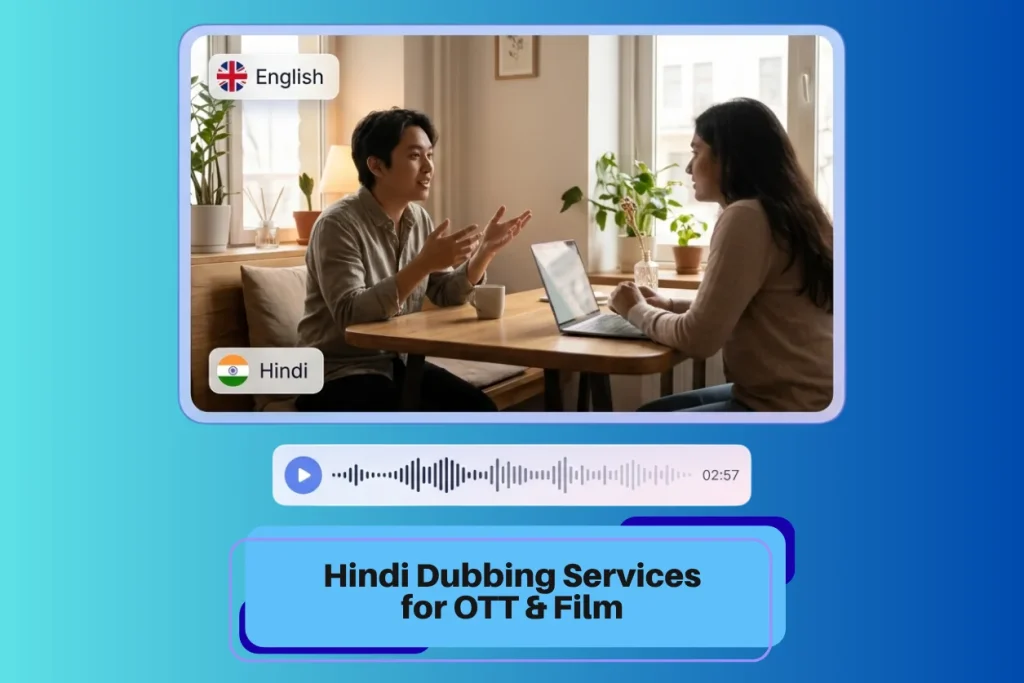
Hindi Dubbing Services for OTT & Film: Reaching India’s 600M+ Hindi-Speaking Audience
Hindi dubbing services for OTT platforms and films help global content creators, streaming giants, and independent filmmakers reach India’s 600 million+ Hindi-speaking audiences by converting video content from any source language into professionally voiced, culturally adapted Hindi — making it watchable, relatable, and commercially viable in one of the world’s fastest-growing media markets. Whether you are distributing a Hollywood blockbuster, launching online courses for Indian learners, or rolling out corporate training videos for a pan-India workforce, high quality dubbing in Hindi is no longer optional — it is the gateway to scale.
Why Hindi Dubbed Movies and OTT Content Dominate India’s Screens
India’s relationship with dubbed content has a rich history. Years ago, the popularity of Hindi dubbed movies — from Hollywood action films to South Korean dramas — proved that Indian audiences do not just tolerate dubbed video; they genuinely prefer watching in their preferred language. Today, that preference has only intensified. OTT platforms like Netflix, Amazon Prime Video, and Disney+ Hotstar have discovered that dubbed movies in Hindi consistently outperform subtitled versions in viewership, completion rates, and subscriber retention across Tier 2 and Tier 3 cities.
The reason is simple: language barriers are real. A gripping story, a mystery-filled quest, or a family drama filled with emotion loses its bond with the audience when viewers are forced to read subtitles instead of being immersed in the audio. When a film or series takes an unexpected turn, it is the voice — its urgency, warmth, or chaos — that carries the moment. Subtitles cannot replicate that. Hindi dubbing gives the audience the full cinematic experience in their own voice, their own world.
This is precisely why global creators are investing in hindi dubbing as a strategic priority, not an afterthought.
The Market Reach Opportunity: India’s Hindi-Speaking Audience by the Numbers
Hindi is spoken by over 600 million people across India, and its reach extends to diaspora communities on virtually every continent. It is the 4th most spoken language globally, written in the Devanagari script and deeply rooted in the cultural life of northern, central, and western India. For OTT platforms, film distributors, and digital content creators, this represents an audience group that rivals the entire population of the European Union — one that is young, mobile-first, and rapidly discovering new video content every day.
When you remove language barriers through professional hindi dubbing, you are not just translating words — you are unlocking market reach in a way that no amount of metadata, subtitles, or google search optimization alone can achieve. Content in the target language of the viewer is simply consumed more, shared more, and remembered more.
Hindi Dubbing Beyond Films: Training Videos, Online Courses & Corporate Content
The demand for hindi dubbing is not limited to entertainment. Across India’s corporate sector, L&D (Learning & Development) teams are localizing training videos and compliance modules into Hindi to improve comprehension and completion rates among frontline and field employees. Global edtech companies are converting online courses into Hindi to discover and serve a massive learner base that struggles with English-only instruction. Government bodies and healthcare organizations are dubbing public service videos to ensure their messages reach every corner of the country.
For all these use cases — whether it is a 90-minute dubbed movie or a 5-minute product tutorial — the principles of high quality dubbing remain the same: accurate translation, culturally adapted script, natural voice delivery that matches the tone of the original audio, and clean post-production that preserves the original music, sound effects, and audio atmosphere.
What Makes Hindi Dubbing Genuinely Effective for OTT & Film
Not every dubbed video lands well with audiences. The difference between forgettable dubbing and immersive dubbing comes down to a few critical elements:
- Voice casting: The right voice for a character’s age, gender, and emotional register. A mysterious villain needs a different voice than an adventurous childhood hero — and both must feel native to Hindi-speaking audiences.
- Script adaptation: A literal word-for-word translation rarely works. Dialogue must be adapted so it fits the lip movement, sounds natural in Hindi, and carries the same emotional weight as the original.
- Lip-sync accuracy: In theatrical and OTT content especially, the bond between the moving image and the dubbed audio must feel seamless. Poor sync breaks immersion instantly.
- Audio quality: The final dubbed audio must sit cleanly within the existing mix — matching the song levels, ambient sound, and overall acoustic space of the original track.
These are not tasks a dubbing tool alone can accomplish. They require experienced voice artists, skilled directors, and production teams who understand both the source material and the target language audience.
Conclusion: Hindi Dubbing Is a Market Strategy, Not Just a Post-Production Step
India’s media market continues to grow at a pace that demands serious localization strategies. For any content creator or distributor who wants to compete for the attention of 600 million Hindi-speaking audiences, investing in high quality hindi dubbing is one of the most direct paths to market reach, viewer loyalty, and long-term commercial success. Whether your video content is a cinematic adventure, an instructional module, or a branded series — the ability to speak to your audience in their own language, with their own voice, is what turns passive viewers into invested fans.
DUBnSUB brings together the professional expertise, native voice talent, and production infrastructure to make that connection happen — reliably, authentically, and at scale.
Frequently Asked Questions (FAQs)
1. What is Hindi dubbing, and how is it different from adding subtitles to a video?
Hindi dubbing replaces the original audio of a video with a new voice track recorded in Hindi, so viewers hear the content in their preferred language without reading. Subtitles display translated text on screen while the original audio plays — functional, but nowhere near as immersive. For films, animation, and training videos, dubbing dramatically increases engagement because the audience watches freely instead of reading. DUBnSUB provides end-to-end hindi dubbing — from script translation and voice casting to studio recording and final delivery — handling everything from full-length dubbed movies to short corporate training videos.
2. Which types of content benefit most from professional Hindi dubbing?
Films, OTT series, animation, and documentaries see the most immediate impact because immersive storytelling depends on voice. But the benefits extend well beyond entertainment — online courses, corporate training videos, and e-learning modules all see higher completion rates when delivered in the learner’s native language. Even YouTube channels targeting hindi speaking audiences grow faster with proper hindi dubbing than with auto-generated subtitles. DUBnSUB serves this full range, from blockbuster hindi dubbed movies and OTT series to eLearning and training videos, with 3,200+ native Hindi voice artists matched to the tone, age, and style each project needs.
3. Is professional Hindi dubbing cost effective for independent creators and smaller OTT platforms?
Yes — reaching 600 million hindi speaking audiences through high quality dubbing costs far less than producing original Hindi content from scratch, making it one of the most cost effective localization decisions a content business can make. For OTT platforms, a Hindi dub on an existing library title can revive past content and attract new subscriber segments without fresh production spend. DUBnSUB’s network of 200+ partner studios keeps pricing competitive while maintaining in-country studio quality, making professional dubbing accessible even for independent creators and smaller platforms not working with major studio budgets.
4. How long does it take to dub a film or OTT series episode into Hindi?
Turnaround depends on content length, complexity, and number of characters involved. A short training video or online course module can often be delivered within a few days, while a full-length film or OTT episode typically takes 5–15 business days per language once translation, casting, recording, and quality checks are factored in. DUBnSUB manages the full production workflow with dedicated project managers at every stage, and for multi-episode content or future projects spanning multiple languages, parallel pipelines are available to compress timelines without compromising quality.
5. Can the same dubbing workflow be used for training videos and corporate content as for films?
The core workflow — translate, cast, record, edit, and deliver — is the same, but corporate and training content has distinct requirements. Technical accuracy matters enormously in compliance training or medical content, and the audio must sync precisely with on-screen visuals rather than lip movements. DUBnSUB has dedicated workflows for training videos and online courses, ensuring terminology is accurately adapted and delivered by Hindi voice artists suited to instructional content. Their team also supports video editing coordination, so L&D teams receive broadcast-ready files with minimal back and forth.
6. What role does cultural adaptation play in Hindi dubbing for Indian audiences?
Cultural adaptation is what separates good hindi dubbing from average dubbing. A line of dialogue that feels tense or funny in English can fall flat — or cause confusion — if translated word for word into Hindi. References tied to family bonds, local events, or social dynamics carry different emotional weight for Hindi-speaking audiences and need to be thoughtfully rewritten, not just translated. DUBnSUB’s script adapters are native Hindi speakers with deep cultural fluency, ensuring your content — whether a family drama, an animation series, or a corporate explainer — connects authentically rather than feeling like a foreign dubbed video.
7. How should a content creator or OTT platform get started with Hindi dubbing?
Start by identifying which titles or videos in your library have the strongest potential with Hindi-speaking audiences — content with wide appeal, strong stories, or clear learning value sees the best return. Then work with a dubbing partner who can handle the full journey: translation, casting, recording, post-production, and delivery in your required format. DUBnSUB is a single point of contact for the entire hindi dubbing process, working with OTT platforms, film distributors, corporate teams, and independent creators alike. Visit https://dubnsub.com/ to request voice samples, discuss your project, or get a tailored quote.