
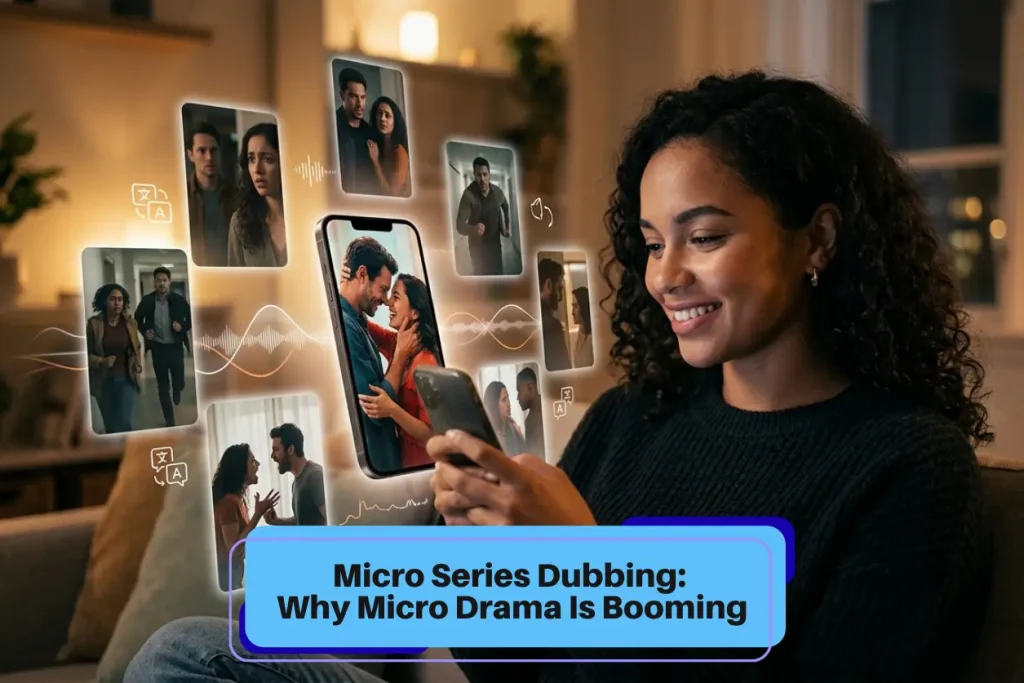
Micro Series Dubbing in 2026: Why Micro Drama Is Booming
Micro drama — episodic short-form video content typically running under 90 seconds per episode — has become one of the fastest-growing entertainment categories on the planet, and dubbing is now the single most important lever for creators and platforms that want to scale it globally. This blog explains why micro drama is exploding across every major market, why language is the biggest barrier standing between a regional hit and a global phenomenon, and how modern dubbing and voice translation have changed what’s possible for content creators, streaming platforms, and media businesses at every level.
Micro Drama and Global Audiences: The Numbers That Matter
The scale of this shift is hard to overstate. China’s microdrama market grew from $500 million in 2021 to $7 billion in 2024 — surpassing the country’s own theatrical box office. Outside China, the global micro drama market generated $1.4 billion in 2024 and is forecast to reach $10 billion by 2030. India is writing its own chapter just as fast: Kuku TV crossed 50 million downloads in six months of launch and was the most downloaded app on Google Play India for two consecutive months. By November 2025, India’s micro-drama apps had collectively surpassed 250 million cumulative downloads, growing 16 times year-on-year.
What makes micro drama stick is simple: it is engineered for the scroll. Episodes are short, emotionally punchy, and built around cliffhangers that pull viewers into the next one. The 18–34 demographic is the engine, often watching five to ten episodes at a stretch. Platforms that built their identities around long-form content — Zee5, MX Player, ShareChat — are all now racing to build dedicated micro drama verticals. The format is no longer a niche experiment. It is the next prime time.
But most of this content is locked inside a single language — and that is where the real opportunity, and the real problem, live side by side.
Why Video Content Without Dubbed Video Is Leaving Money on the Table
A Korean revenge drama, a Chinese CEO romance, a Hindi family series from Tier-2 India. These stories are emotionally universal. But if a viewer in Brazil, Italy, or Japan cannot understand the dialogue, the content does not exist for them in any meaningful way.
Subtitles help at the margins, but dubbed video is what drives genuine cross-border engagement. Audiences who hear content in their own language — matched to the original tone, emotion, and timing — connect with characters at a level that reading text at the bottom of a frame simply cannot replicate. For micro drama in particular, where every second of a video file has to carry emotional weight, a well-dubbed video is the difference between a viewer clicking away and binge-watching the entire series.
Traditional dubbing was never built for the pace of micro drama content creation. Booking studios, scheduling voice actors, syncing audio frame by frame — that process takes weeks and costs money most independent creators don’t have. Micro series dubbing at scale — think a 60-episode run going into Spanish, French, Hindi, Japanese, Korean, and Chinese simultaneously — would be a production nightmare under any legacy model. Modern dubbing technology changes the math entirely.
Modern Dubbing and Voice Translation: The New Engine of Content Creation at Scale
Modern dubbing technology handles the full pipeline — transcription, translation, voice synthesis, and lip-sync — in a fraction of the time traditional dubbing required, while preserving tone, pacing, and the emotional texture of the original audio. For micro drama dubbing specifically, this matters enormously. Consistent character voice across 60+ short episodes in multiple languages is where a capable video translator outperforms anything legacy pipelines can offer at speed and cost.
Critically, the best dubbing solutions today handle multiple speakers cleanly — identifying who is speaking, when, and with what emotion — and produce dubbed video that does not just translate words but carries the feeling across into the new language. Voice overs that flatten a character’s personality across multiple languages are not good enough for a format where emotional nuance is everything.
Voice Cloning and Fine-Tune Capability: Where Quality Meets Scale
Voice cloning takes dubbing a step further. Rather than assigning a generic replacement voice, voice cloning replicates the original speaker’s voice characteristics — pitch, cadence, style — and expresses them in a different language. The character sounds like themselves in Hindi, Spanish, French, or Japanese. For creators building long-running micro drama IP with recurring characters, this is a content strategy decision, not just a technical one. It protects the emotional identity of your characters across every dubbed video in your catalogue.
The ability to fine-tune voice output — adjusting pacing, register, and cultural fit for each market — is what separates a serviceable dubbing tool from a professional-grade solution. This is especially true in micro drama dubbing, where a mismatched tone in a 60-second episode can break the emotional arc the whole series is built on.
Real-Time Dubbing: The Next Frontier
The horizon for voice translation in video content is real time dubbing — generating dubbed audio during live streams without meaningful delay. For platforms already investing in micro series dubbing at volume, adding real-time capability on top is a natural next step. For those experimenting with live micro-drama events or interactive storytelling formats, it will be a defining competitive advantage. The technology is advancing fast, and for content businesses with global ambitions, it is worth building into the content strategy now rather than retrofitting it later.
Frequently Asked Questions (FAQs)
1. Why does micro drama need dubbed video rather than just subtitles?
Subtitles split the viewer’s attention between reading and watching — which is a real problem in a format where every second on screen has to deliver emotional impact. Dubbed video keeps eyes on the action and lets tone and pacing land as intended. Viewers in dubbed markets consistently show higher completion rates and stronger binge behaviour, which directly affects platform engagement and monetisation.
For micro drama series dubbing at professional quality, DUBnSUB delivers native-quality dubbing across 100+ languages — built for the emotional precision that short-form drama demands and compatible with major OTT platforms.
2. Can modern dubbing handle multiple speakers accurately across a long micro drama series?
Yes, and handling multiple speakers accurately is one of the core requirements for any micro drama dubbing workflow. Professional dubbing systems identify and distinguish each speaker, assign consistent voices across episodes, and synchronize dialogue with lip movements. Fast, dialogue-heavy conversations — the backbone of micro drama — require precise speaker detection and voice matching to work.
DUBnSUB’s dubbing pipeline is built for multi-speaker, high-volume content, making it well-suited to episodic micro drama production at scale.
3. What is voice cloning and how does it benefit a micro drama creator?
Voice cloning replicates the original speaker’s voice and expresses it in a new language, so characters retain their vocal identity across every dubbed version. For a series with recurring characters across multiple seasons and multiple languages, this consistency matters — it is what makes a Spanish or Japanese viewer feel the same connection to a character as the original audience did.
DUBnSUB integrates voice cloning into its localization services, preserving character authenticity across Hindi, Korean, French, Italian, Chinese, Spanish, and beyond.
4. Which languages should micro drama creators prioritize for dubbing?
The highest-opportunity markets outside China for micro drama are the US, Japan, India, Southeast Asia, and Latin America. That translates practically to Spanish and Portuguese for the Americas, Hindi for South Asia, Japanese and Korean for East Asia, and French for francophone markets. Genre matters too — romance and revenge narratives over-index in specific regions, which should shape your rollout.
DUBnSUB can advise on language prioritization as part of a project consultation, drawing on production experience across 100+ languages and 50+ countries.
5. Does dubbing fit only large studios, or can independent micro drama creators access it too?
The economics of dubbing have changed. Advances in production workflows have brought the cost of professional dubbing down substantially, making highest quality output accessible to independent creators and smaller production houses — not just major studios. The key is finding a partner that can deliver professional results without the overhead of legacy production.
DUBnSUB offers per-project, transparent pricing based on content duration, language pair, and service type — making professional micro drama dubbing and micro series dubbing accessible to creators at any scale, without the overhead of legacy production models.
6. How does dubbing fit into a broader micro drama content strategy?
Dubbing is a distribution decision, not just a translation exercise. Whether you are planning micro drama dubbing for a single series launch or building a multi-season micro series dubbing roadmap, questions like when to release dubbed versions, which languages to prioritize for which platforms, and how to position dubbed content in different markets all affect how your series performs globally. Creators who build dubbing into their content rollout from the start — rather than treating it as a post-production afterthought — build bigger audiences faster.
DUBnSUB works with creators and platforms to integrate dubbing and voice translation into the production pipeline early, enabling faster delivery, higher quality, and a coherent global release strategy.
7. What should I look for in a professional video translator for micro drama content?
Not all dubbing and video translation solutions are built the same way. For micro drama, the priorities are speed, multi-speaker accuracy, voice consistency across episodes, and cultural fit in each target language — none of which a basic transcription or auto-translate tool can reliably deliver. The difference between a generic solution and a professional one shows up immediately in how tone and emotion survive the language change.
DUBnSUB pairs expert localization with rigorous human review at every quality checkpoint — ensuring that your dubbed video meets broadcast standards while still moving at the pace that micro drama content creation demands.
Ready to take your micro drama to a global audience? DUBnSUB offers professional dubbing, voice-over, and subtitling services across 100+ languages. Get in touch at https://dubnsub.com/ to discuss your project.