
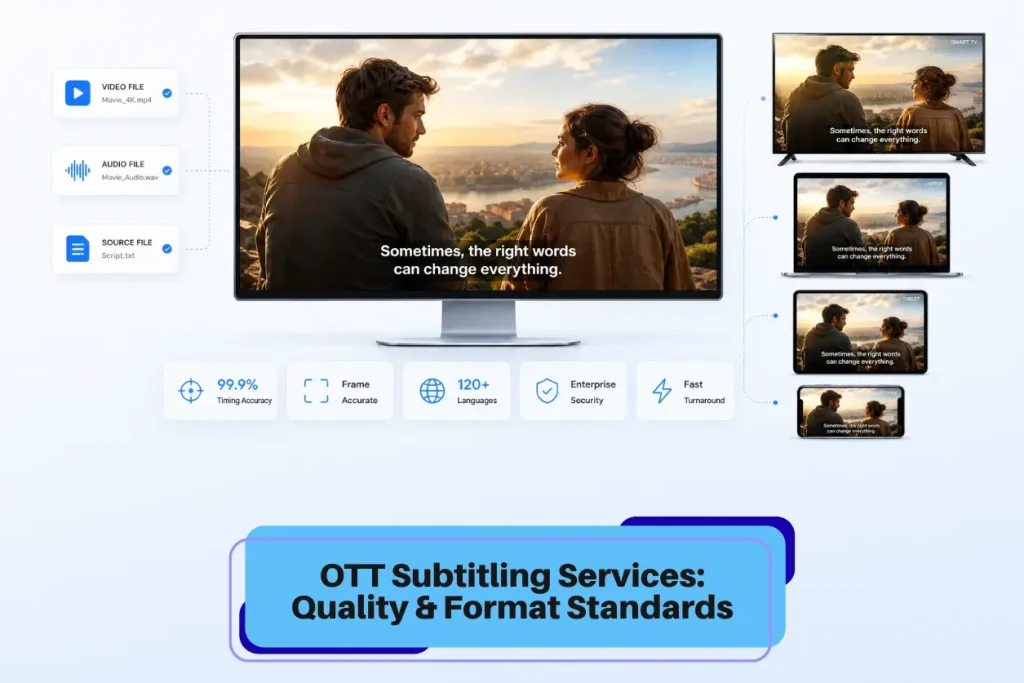
OTT Subtitling Standards: Understanding Professional Quality Requirements
OTT subtitling services convert spoken dialogue in movies, TV programs, documentaries, and live events into time-synced, accurately translated text that meets the technical and accessibility requirements of streaming platforms. Professional subtitling services follow structured quality standards covering timing (160-180 words per minute display speed), file formats (SRT, WebVTT, TTML), speaker identification, and cultural accuracy — with human subtitlers achieving up to 99% accuracy across major streaming, corporate, and educational content types. This blog breaks down what those standards actually mean, why they matter for global audiences, and how to evaluate a subtitling partner for your video content.
Why OTT Subtitling Services Matter for Global Audiences
Streaming platforms operate across dozens of countries and language markets simultaneously, which is why subtitles have become a baseline expectation rather than an add-on. Subtitles help reach international audiences in 100+ languages, letting a single piece of video content travel across cultural and linguistic borders without a full dub. Subtitling services also improve viewer engagement and comprehension — subtitled content can increase watch time by 78%, and roughly 80% of viewers aged 18-25 regularly use subtitles, even when watching in their native language.
There’s an accessibility dimension too. Roughly 15% of U.S. adults, or about 37.5 million people, report some degree of hearing difficulty. Same-language captions and SDH subtitles aid comprehension for deaf or hard-of-hearing viewers, and subtitling supports legal compliance with accessibility regulations such as the ADA and FCC standards in various countries. On the discoverability side, subtitles allow search engines to index video content, meaning subtitled content is more visible in search results because the dialogue exists as searchable, indexed text.
Subtitling Services vs Closed Captioning: Knowing the Difference
A common point of confusion for media teams is the difference between subtitles and captions. Subtitles focus on dialogue, typically written for viewers who can hear the audio but don’t understand the language spoken, or for viewers watching without sound. Captions provide same-language dialogue along with sound descriptions, and closed captions are designed specifically for deaf and hard-of-hearing viewers, including sound effects and other non-dialogue audio cues.
SDH (Subtitles for the Deaf and Hard of Hearing) subtitles sit at the intersection of both: they include speaker identification and sound cues like [door slams] or [phone ringing], combined with the translated or transcribed dialogue itself. Open subtitles are burned directly into the video file, while closed captions and standard subtitles can be toggled on or off by the viewer. Knowing which format a project needs — subtitle translation, transcription, or full SDH — is the first decision point in any subtitling process.
Subtitle Translation Services: From Original Language to Target Language
Subtitle translation services convert spoken dialogue in the original language into a target language while preserving meaning, tone, and timing. This is different from a plain text translation. A translator working on subtitle text has to compress spoken dialogue into a limited number of characters per line, match the pacing of the original audio, and account for cultural context that doesn’t translate literally.
This is where native language experts make a measurable difference. Professional subtitlers working in their native language understand idioms, humor, proper nouns, and industry terminology in ways that generic translation can’t replicate. Localized subtitles that ignore cultural nuances often feel stilted or lose the emotional beat of a scene — a joke that lands in English can fall flat in a foreign language if translated word-for-word instead of adapted for cultural relevance. This attention to cultural adaptation is especially important for foreign films and TV programs being distributed to global markets, where audiences expect the humor, tone, and register of the original to carry through.
English Subtitles, Foreign Language Dialogue, and Multiple Speakers
Not every subtitling project runs in a single direction. Some projects need English subtitles added to foreign-language films for international distribution. Others need dialogue originally spoken in English translated into multiple languages for global streaming rollout. Both directions call for the same underlying discipline: accurate subtitles that reflect exactly what characters speak, correctly attributed when there are multiple speakers on screen.
Speaker identification becomes especially important in scenes with overlapping or multiple speakers, where subtitle text needs to clearly indicate who is speaking, particularly for hard-of-hearing viewers who can’t rely on tone of voice or accent to tell speakers apart. Sound effects, background noise, and shifts in audio quality also need to be accounted for so that the final subtitle file accurately represents the audio content rather than approximating it.
The Subtitling Process: From Subtitle File to Final Formatting
The subtitling workflow generally moves through five stages: transcription of the original audio, translation (if the project calls for a target language different from the original), timing of the subtitle text against the spoken dialogue, formatting into the required subtitle formats, and a final quality control pass.
Professional subtitlers use specialized editing tools to sync subtitle text with correct timing, keeping display speed in the 160-180 words-per-minute range so viewers can comfortably read without falling behind the audio. Subtitling involves a four-stage quality review process that checks timing accuracy, spelling, terminology consistency, and adherence to the client’s subtitle formats and style guide. Human review at this stage catches errors that automated timing tools miss — particularly in educational content, corporate videos, and other material where technical or industry terminology needs to be correct on the first pass.
SRT Files and Other Major Formats for OTT Platforms
Once a subtitle file passes quality control, it needs to be delivered in the file formats a given platform requires. SRT files remain the most widely used format across YouTube videos, corporate video libraries, and many streaming platforms, largely because of how simple the format is to work with. OTT platforms, however, often require subtitles in multiple formats, including SRT, WebVTT, and TTML, depending on their player technology and accessibility requirements.
Media teams preparing content for several streaming platforms at once should confirm format requirements early, since reformatting an existing subtitle file for a new platform is far faster than starting the subtitling process over. Viewers should also be able to download subtitles or select from multiple formats where a platform supports it, since not every playback environment reads every format identically.
What Drives Subtitling Costs and Turnaround
Subtitling costs depend on project complexity and turnaround time, among other factors. A single-language SRT file for a short corporate video costs and takes far less time than SDH subtitling with speaker identification across multiple languages for a full-length feature film. Live captioning for a real-time event adds its own layer of complexity compared to subtitling pre-recorded video content, since there’s no room to revise timing after the fact.
Media teams budgeting for subtitling needs should factor in the number of target languages, the length and density of spoken dialogue, whether SDH or accessibility-compliant captioning is required, and how quickly the final files need to be delivered. Best professional subtitling services will typically walk clients through these variables up front rather than quoting a flat per-minute rate that doesn’t account for project-specific complexity.
Choosing a Subtitling Partner for Your Video Content
Subtitling services vary widely in how they handle the details that determine whether subtitles actually work for an audience — timing precision, cultural adaptation, speaker identification, and format compliance across the major formats each platform requires. Native speakers working as professional subtitlers, rather than generic translators, tend to produce subtitles that read naturally in the target language rather than sounding translated.
This is the standard DUBnSUB’s subtitling and language services team works to on every project. Our native-language experts handle subtitle translation, SDH subtitling, closed captioning, and multi-language localization for OTT platforms, corporate videos, and foreign films, with a four-stage quality review built into every subtitling process. If your media team needs subtitles across multiple languages and formats, DUBnSUB’s team can walk through your project’s specific subtitling needs and turnaround requirements.
Frequently Asked Questions (FAQs)
1. What’s the difference between subtitles and closed captions?
Subtitles translate or transcribe spoken dialogue into written text, typically for viewers who don’t understand the language spoken or are watching without audio. Closed captions go a step further, including sound effects and other audio cues, and are designed specifically for deaf and hard-of-hearing viewers. DUBnSUB provides both standard subtitles and closed captioning, including SDH formats, so media teams can choose the right option for their audience and accessibility requirements.
2. What file formats do OTT platforms require for subtitles?
Most OTT platforms accept SRT files, but many also require WebVTT or TTML depending on their player technology and accessibility standards. Requirements can vary by platform, so it’s worth confirming format needs before starting a project. DUBnSUB delivers subtitle files in all major formats and can reformat existing subtitle files for new platforms without restarting the subtitling process from scratch.
3. How accurate are professional subtitles?
Human subtitlers can achieve up to 99% accuracy, particularly when a four-stage quality review process checks timing, spelling, and terminology before delivery. Automated or machine-only subtitling tends to fall short on cultural context, industry terminology, and proper nouns. DUBnSUB relies on native-language experts and a structured QC process to keep accuracy consistently high across projects.
4. What are SDH subtitles, and when are they needed?
SDH (Subtitles for the Deaf and Hard of Hearing) subtitles include speaker identification and sound cues alongside the dialogue itself, making them suitable for viewers who are deaf or hard of hearing. They’re increasingly a standard requirement for streaming platforms and accessibility compliance. DUBnSUB’s subtitling team builds SDH formatting into projects that need it, including proper speaker labeling for scenes with multiple speakers.
5. How does subtitle translation handle cultural context and humor?
Direct, word-for-word translation often loses jokes, idioms, and cultural references that don’t carry the same meaning in another language. Professional subtitlers adapt dialogue for cultural relevance while preserving the original intent and timing. DUBnSUB’s native-language subtitlers handle this cultural adaptation as a core part of the subtitle translation process, not an afterthought.
6. What determines subtitling costs and turnaround time?
Cost and turnaround depend on factors like the number of target languages, whether SDH or accessibility captioning is needed, dialogue density, and delivery deadlines. Live events also require different handling than pre-recorded video content. DUBnSUB provides project-specific quotes based on these factors rather than flat per-minute pricing, so media teams know what they’re paying for.
7. Can subtitles help with SEO and content discoverability?
Yes — subtitle text is indexable by search engines, which means subtitled video content tends to be more visible in search results than video without a text layer. This applies to YouTube videos as well as content hosted on OTT platforms. DUBnSUB includes properly formatted subtitle files as part of every project, giving media teams an SEO benefit alongside the accessibility and translation value.