
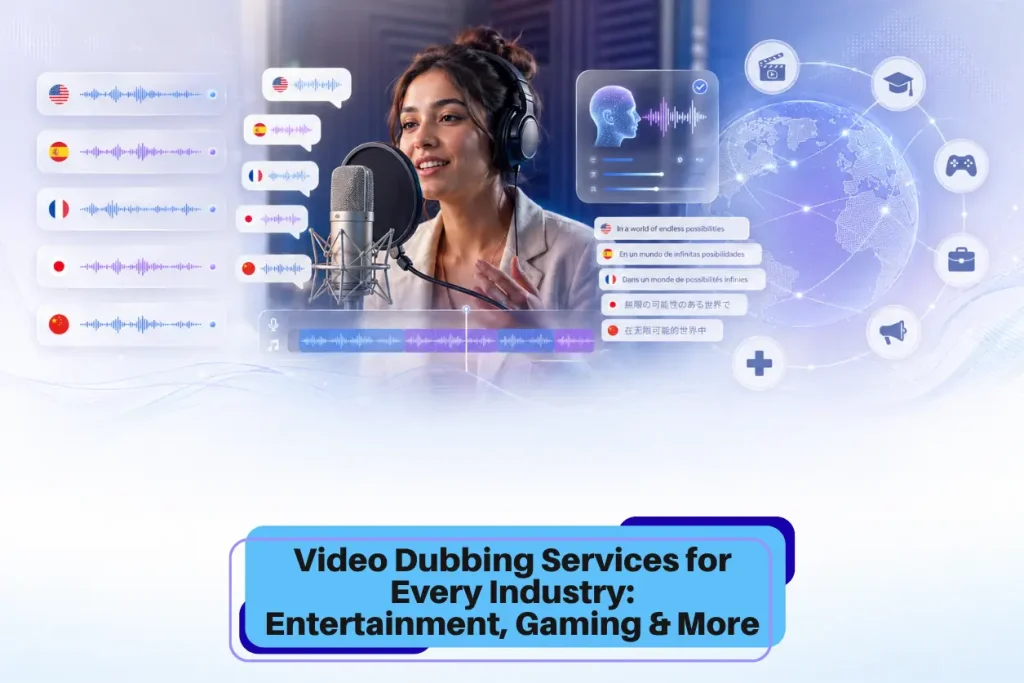
Video Dubbing Services for Every Industry: Entertainment, E-Learning, Gaming & More
Video dubbing services replace the original audio of a video with professionally recorded translated audio in a target language, making content immediately accessible to global audiences in their native language. From entertainment and OTT streaming to e-learning, gaming, healthcare, and corporate communications, professional video dubbing enables businesses and content creators to deliver their message across multiple languages — without losing the tone, emotion, or original meaning of the source content. DUBnSUB provides end-to-end video dubbing and voice over in 100+ languages, serving every major industry with professional voice actors, studio-quality recording, and a seamless workflow built for scale.
Why Global Audiences Expect More Than Just a Dubbed Video
The demand for localized video content has never been higher. Approximately 70% of people worldwide access online video content monthly, and the majority prefer consuming that content in their own native language. For businesses distributing video content across Latin America, Europe, Asia, and the Middle East, delivering a high-quality dubbed version is now a competitive standard — not an optional upgrade.
Unlike traditional subtitling, video dubbing fully replaces the original audio track with a translated audio track in the target language, delivered by professional voice actors who match the tone, pacing, and energy of the original speaker. The result is a viewing experience that feels native to a wider audience — removing language barriers entirely and making original content feel as though it was produced locally.
When done well, the dubbing process preserves the original meaning and emotional resonance of the source language while making it fully accessible in other languages. This is why video dubbing services remain the gold standard for content localization across industries — and why the global dubbing market is growing at nearly 10% annually.
Entertainment & OTT: Setting the Benchmark for AI Video and Cinematic Quality
Entertainment remains the largest consumer of professional video dubbing globally. Streaming platforms now routinely commission dubbed versions of original productions across 20 or more languages simultaneously — placing significant demands on recording studios, voice actors, and post production teams alike.
For film, television, and OTT content, the dubbing process requires precise lip sync alignment, where translated dialogue is carefully adapted to match the speaker’s mouth movements. Professional voice actors are cast not just for linguistic accuracy but for their ability to match the emotional quality of the original speaker’s voice. The original audio track is retained as a reference throughout post production to ensure consistency with the original version.
AI video tools have entered this space and can support workflows for lower-stakes content. However, for premium OTT and theatrical releases, the emotional nuance, lip synchronization accuracy, and character-specific performance that human professional voice actors deliver remain the industry standard.
E-Learning & Corporate: Training Videos That Speak Every Language
For e-learning providers, corporate L&D teams, and HR departments, multilingual content is a business requirement. Training videos available in only one language create real comprehension barriers for distributed teams and international learners. Professional video dubbing transforms educational content and training videos into fully localized experiences — improving understanding, retention, and engagement compared to subtitle-only alternatives.
Unlike traditional dubbing for entertainment, corporate video dubbing often involves multiple speakers — presenters, narrators, subject matter experts — across longer videos. A seamless workflow that manages multiple speakers, consistent voice talent, and accurate translated audio is critical for quality output at scale.
Human translators are essential for this category. The original meaning of compliance training, technical instruction, and HR policy content must be preserved with precision across every target language — making professional voice actors and specialist linguists non-negotiable components of a quality production process.
Gaming: How AI Dubbing Work Shapes Immersive Localization
The gaming industry represents one of the fastest-growing segments in video dubbing services. As games become increasingly cinematic — with complex narratives, character-driven dialogue, and interactive storytelling — the need for high-quality dubbing across multiple languages has grown significantly.
Game dubbing involves unique production challenges. Voice actors must deliver character-specific performances across potentially thousands of lines of dialogue, maintaining consistent speaker identity and emotional range throughout. Audio file management, recording studios coordination, and post production requirements for game projects are considerably more complex than standard video dubbing.
AI dubbing work using artificial intelligence is now commonly used for secondary characters or high-volume secondary dialogue in gaming pipelines. For hero characters, cut-scenes, and story-critical content, however, professional voice actors and human direction remain the standard for studios that prioritize quality and player immersion.
A Note on AI Dubbing Tools and AI Video Translation
AI dubbing tools and AI video translation platforms have expanded rapidly. Many allow users to upload a video or audio file, select languages from the available languages list, and receive an automatically translated dubbed version using AI voice technology. Some platforms use voice cloning to approximate the original speaker’s voice characteristics, with generative AI producing synthetic translated audio.
For simple, single-speaker content with minimal background noise and clear speaker identity, an AI video dubbing tool can offer meaningful production time savings. These platforms work reasonably well for basic explainer videos, short social content, or internal communications where speed matters more than emotional precision.
However, AI dubbing tools have clear limitations. Voice cloning cannot consistently preserve the speaker’s unique voice characteristics across different language outputs. Lip synchronization and alignment with speaker’s mouth movements remain imprecise for most automated platforms. Emotional nuance, cultural adaptation, and the natural performance quality that professional voice actors bring are not reliably replicated by AI voice generation — particularly for longer videos with multiple speakers.
For content where audience trust, brand credibility, and viewing quality matter, professional human-led dubbing remains the reliable standard. AI dubbing is best used as a workflow support tool rather than a complete replacement for studio production.
What Languages Are Supported Across Industries?
One of the most common questions buyers ask before commissioning a dubbing project is what languages are supported. The answer depends on the provider. Professional dubbing studios work across a wide range of available languages — from the world’s most widely spoken including Spanish, French, Mandarin, Arabic, Hindi, and Portuguese, to regional and less commonly served languages across Africa, Southeast Asia, and the Middle East.
For industries serving Latin America, the distinction between Latin American Spanish and Castilian Spanish matters for accuracy and audience reception. For Asian markets, the following languages see the strongest demand: Mandarin, Japanese, Korean, Hindi, Tamil, and Bahasa Indonesia. European buyers commonly require select languages including French, German, Italian, Spanish, Polish, and Dutch.
When evaluating a dubbing partner, confirming not just that a language appears in the list but that the provider has native-speaking professional voice actors and human translators for that specific language — rather than machine translation outputs — is essential to production quality.
DUBnSUB offers professional video dubbing and voice over in 100+ languages, with native-speaking voice talent and linguists across all major global markets and industries.
DUBnSUB offers combined dubbing and subtitling services across 100+ languages, allowing clients to meet platform requirements and accessibility standards with a single, streamlined production partner.
Ready to take your video content global? Contact DUBnSUB for a free consultation: https://dubnsub.com/
Frequently Asked Questions (FAQs)
1. How does video dubbing work?
Video dubbing replaces the original audio of a video with a newly recorded translated audio track in a different language. Professional voice actors record the translated dialogue in recording studios, matching the pacing, tone, and lip sync of the original speaker. The new audio track is then synced to the video in post production, replacing the original audio track while preserving all visual content.
At DUBnSUB, our video dubbing process covers everything from script translation and voice casting to studio recording and final delivery — across 100+ languages and all major video content formats.
2. Which industries benefit most from professional video dubbing services?
Video dubbing services are used across entertainment, OTT streaming, e-learning, gaming, corporate communications, healthcare, advertising, and documentary production. Any industry that distributes video content to audiences in multiple languages — and needs that content to feel native rather than translated — benefits from professional dubbing over subtitles alone.
DUBnSUB serves all of these verticals with tailored dubbing solutions, dedicated voice talent, and industry-specific production experience across 100+ languages.
3. Can an AI dubbing tool replace professional voice actors?
An AI dubbing tool works well for basic, high-volume, or low-stakes content — particularly for a single speaker in clean audio conditions. However, AI dubbing falls short on emotional nuance, precise lip synchronization, cultural adaptation, and character-specific performance. For content where audience engagement, brand credibility, and quality matter, professional voice actors deliver results that AI voices cannot consistently match.
DUBnSUB uses a human-led production model for all projects, ensuring every dubbed video meets professional broadcast and streaming standards across all target languages.
4. How long does the video dubbing process take?
Production time depends on content length, the number of languages, the number of speakers, and the complexity of the source material. A short corporate video can be turned around in a few days; a full OTT series across multiple languages requires a longer production schedule. Longer videos with multiple speakers naturally require more studio time and post production work.
DUBnSUB provides clear project timelines upfront and can accommodate priority turnarounds without compromising output quality.
5. What file formats are accepted for video dubbing projects?
Most professional dubbing studios accept all common video or audio file formats. You can upload your video in standard formats including MP4, MOV, AVI, WAV, and MP3. The dubbing studio extracts the original audio track from the video or audio file and begins the translation and recording process from there.
DUBnSUB accepts all standard video and audio formats and integrates smoothly into clients’ existing production workflows for a seamless handover process.
6. Can dubbing handle content with multiple speakers?
Yes. Professional video dubbing services are fully equipped for content with multiple speakers. Each speaker’s voice characteristics are matched through careful casting of professional voice actors, and speaker identity is maintained consistently throughout the dubbed version — whether the content features two presenters or an ensemble cast.
DUBnSUB manages multi-speaker dubbing projects across all industries — from interview-based documentaries and panel training videos to gaming cut-scenes with large character casts.
7. Does DUBnSUB offer subtitle generation alongside dubbing?
Yes. Many clients require both a dubbed version and subtitles for the same content — especially for OTT platforms where accessibility standards and viewer preferences demand multiple language options. Subtitle generation can be delivered alongside dubbing as part of an integrated localization package, covering the same target languages in a single production workflow.