
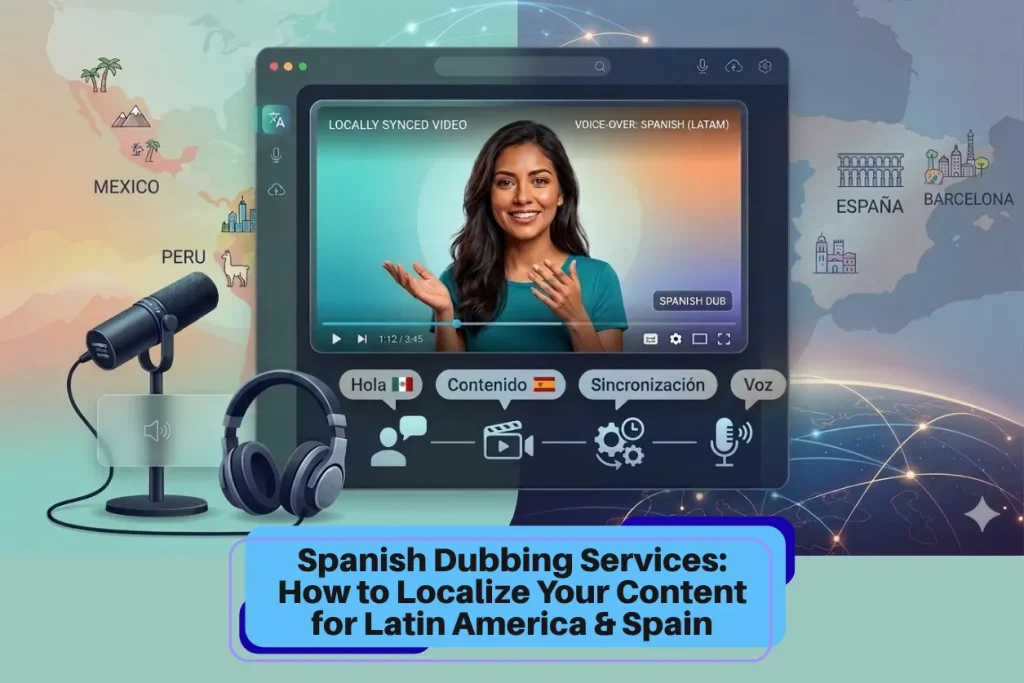
Spanish Dubbing Services: How to Localize Your Content for Latin America & Spain
Spanish dubbing is the process of replacing the original audio in a video or film with professionally recorded Spanish voice tracks — but delivering it right means choosing between two very distinct worlds: Latin America and Spain. With over 500 million native speakers spread across more than 20 spanish speaking countries, Spanish is the second most widely spoken native language in the world. For any business or content creator looking to connect with audiences across latin american countries, south america, central and south america, and the Iberian Peninsula, understanding the linguistic, cultural, and regional differences is not a luxury — it is a necessity.
Why Spanish Is Not One-Size-Fits-All
The spanish language is rich, alive, and gloriously varied. What works perfectly in Mexico City may sound odd in Buenos Aires, and what resonates in Madrid can feel foreign on the Caribbean coast. When approaching dubbing services for Spanish-speaking markets, the single most important thing to understand is that “Spanish dubbing” is never just one thing — it is a spectrum.
There are significant differences in vocabulary, pronunciation, and grammar between the Spanish spoken in spain and the Spanish spoken across latin america. Even within each region, dialects shift considerably. The important differences extend beyond simple word swaps: they affect tone, cultural nuance, rhythm of speech, and how naturally a voice sounds to the ear of a local audience.
Latin American Spanish vs. Spanish from Spain: The Important Differences
Pronunciation and Sound
One of the most immediately recognisable important differences between spain and latin american spanish is pronunciation. In northern spain and much of the peninsula, the letters c (before e or i) and z are pronounced like the English th — a feature known as the Castilian lisp. In southern spain, particularly in Andalusia and the canary islands, this distinction softens. Across latin america, however, both sounds merge into an s — called seseo — which is what the vast majority of Spanish speakers in the world actually use.
When audiences hear a dubbed voice, they pick up on these sounds immediately. A voice that does not sound right for the region breaks immersion and diminishes engagement.
Vocabulary: Where Words Differ
Words differ considerably across regions. In spain, a car is a coche; in argentina, colombia, and much of central and south america, it is a carro. A computer is an ordenador in Spain but a computadora or computador in most of latin america. Caribbean countries have their own set of expressions, as do the southern cone nations like chile and argentina. Even everyday phrases and slang expressions shift from country to country. A dubbing script that uses vocabulary native only to one region will sound unnatural — or even unintelligible — in another.
Grammar: Voseo, Tuteo, and the Formal Ustedes
Grammar is another area of significant differences. In most of latin america, the formal ustedes is used as the plural “you” in both formal and informal speech. In spain, the informal vosotros is common in everyday speech, a form that is nearly absent across latin american countries. Additionally, countries like argentina and paraguay use vos instead of tú — a feature called voseo — which affects both vocabulary and conjugation patterns. For dubbing, these grammatical choices must be correct for the target region or the localization will feel inauthentic.
LATAM Spanish Dubbing: A Regional Breakdown
LATAM Spanish dubbing — also referred to as latin american spanish dubbing — is often produced using what is broadly called standard spanish or “neutral Spanish”: a general register designed to be understood across latin american countries without sounding strongly tied to any one country. This approach is common for films, series, and corporate content targeting the region broadly.
However, for content aimed at a specific country — say, a colombia-focused marketing campaign or a costa rica regional broadcast — localisation should reflect local dialects, accents, and culture. The same applies to south america: argentina and chile, for example, have such distinctive regional differences in pronunciation and vocabulary that content intended for those audiences deserves dedicated localisation rather than a generic pan-regional version.
It is also worth noting that parts of latin america are home to indigenous languages — Quechua, Nahuatl, Guaraní, and dozens of other languages — which coexist with Spanish and influence regional vocabulary and expression. A truly culturally attuned localization team will account for these layers.
Dubbing for Spain: Don’t Overlook the Regional Differences
Spain itself is linguistically diverse. While Castilian Spanish is the dominant official language, regional differences are pronounced. Northern spain sounds different from southern spain, and the canary islands share phonetic features closer to latin american spanish than to Castilian. Beyond these, Spain is home to other languages such as Catalan, Galician, and Basque, which may be relevant depending on where your content will be distributed.
Spanish dubbing for Spain requires native spanish speakers who understand the Castilian register, appropriate use of vosotros, and culturally specific expressions — none of which translate directly from latin american spanish.
Voice Over vs. Dubbing: What Does Your Content Need?
Voice over and dubbing are related but distinct services. Voice over typically involves a translated narration track laid over the original audio — common in corporate films, documentaries, podcasts, and e-learning. Dubbing, on the other hand, fully replaces the original dialogue with lip-synced translations, making it the preferred choice for films, TV series, animations, and OTT content.
For the spanish language market — whether targeting spain or the vast majority of Spanish speakers across latin america — both services demand native talent with regional fluency. The quality of your localization depends entirely on who is behind the microphone and the expertise of the post-production team shaping the final sound.
Final Thoughts
Reaching the vast majority of the world’s Spanish speakers — across latin america, spain, and beyond — requires more than a word-for-word translation. It requires a genuine understanding of how regional differences, dialects, culture, and pronunciation shape the way people hear and connect with content. From south america to the Iberian Peninsula, great spanish dubbing is what turns a foreign production into something an audience can call their own.
Whether you need a single neutral LATAM Spanish dubbing version or country-specific dubbing services for multiple spanish speaking countries, partnering with an experienced localization team makes all the difference.
Frequently Asked Questions (FAQs)
1. Do I need separate Spanish dubbing versions for Latin America and Spain?
In most cases, yes. The important differences in vocabulary, pronunciation, and grammar between spain and latin american countries mean that a single track often does not serve both audiences equally well. A Castilian dub sounds distinctly foreign to audiences in mexico or argentina, and vice versa. DUBnSUB offers dedicated spanish dubbing tracks for both markets — including LATAM Spanish and Castilian Spanish versions — ensuring each audience hears content that feels native to them.
2. What is ‘neutral Spanish’ or ‘LATAM Spanish’ and when should I use it?
Neutral or standard spanish — commonly called LATAM Spanish in the industry — is a general latin american spanish register designed to be broadly understood across central and south america without strong regional accents. It works well for pan-regional entertainment, e-learning, and corporate content where targeting a single country is not the goal. DUBnSUB’s linguists and voice talent are experienced in delivering both LATAM Spanish dubbing and country-specific versions depending on your distribution strategy.
3. How do Spanish dialects affect dubbing quality?
Dialects significantly influence how natural and credible a dubbed voice sounds to local audiences. Viewers in colombia, chile, or the caribbean will notice if the accents and phrases don’t match their region. DUBnSUB works with native spanish speakers from across the Spanish-speaking world, matching voice talent to the target region to ensure the final sound is authentic and engaging.
4. Are indigenous languages relevant to Spanish content localization in Latin America?
Yes, particularly for content targeting rural or indigenous communities in south america and central and south america. Indigenous languages such as Quechua, Guaraní, and Nahuatl have millions of speakers, and they also influence the words, rhythm, and expressions of regional latin american spanish. For highly localised projects, DUBnSUB’s experienced team can advise on the right approach and connect you with specialists in these language communities.
5. Is voice over a good alternative to full dubbing for Spanish-speaking markets?
Voice over is a cost-effective option for corporate videos, documentaries, training content, and podcasts where full lip-sync is not required. It works well when post-production timelines are tight or budgets are constrained. DUBnSUB provides both professional voice over and full dubbing services in LATAM Spanish and Castilian Spanish, so you can choose the format that best suits your content type and audience.
6. How many Spanish-speaking countries can DUBnSUB cover for dubbing projects?
Spanish is the official or co-official language in over 20 spanish speaking countries, spanning spain, mexico, colombia, argentina, chile, costa rica, paraguay, the caribbean nations, and more. DUBnSUB has voice talent and production capabilities across this full geography, with partner studio networks and native linguists from across the Spanish-speaking world to handle both large-scale and regional projects.
7. What makes a Spanish dubbing service truly professional?
A professional spanish dubbing service combines accurate translation, culturally aware adaptation, skilled native spanish speakers as voice talent, precise lip-sync matching, and rigorous quality control in post-production. The difference between passable and excellent dubbing often comes down to the experienced team behind the project. DUBnSUB brings together translators, voice directors, native voice actors, and sound engineers with deep expertise in Spanish localization — ensuring your content doesn’t just speak the language but truly sounds like it belongs there.